

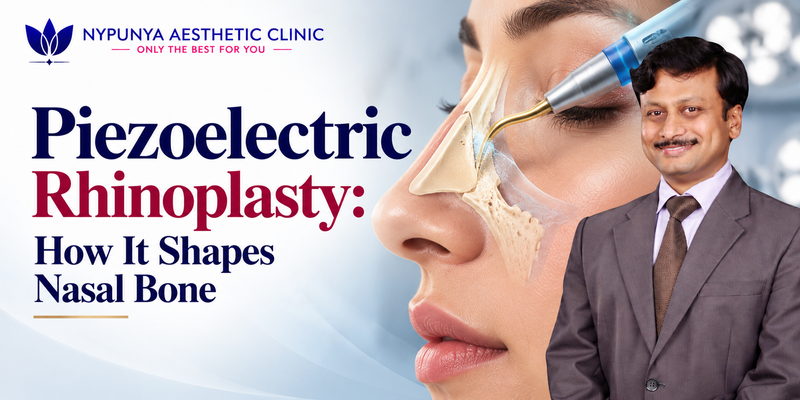
Piezo Rhinoplasty: How It Shapes Nasal Bone
[By Dr. Prashantha Kesari N.K. | Nypunya Aesthetics Clinic, JP Nagar, Bengaluru ]
Inside the piezo handpiece, piezoelectric crystals convert electrical energy into ultrasonic vibrations, typically operating at 25 to 29 kHz. This is the same core principle behind piezosurgery for nose procedures in other specialties, ultrasonic energy that cuts mineralized tissue while softer structures, including blood vessels, nerves, skin, and mucosa, tend to deform and move away rather than being severed. This tissue-sparing behavior is a design advantage, not a guarantee of zero soft-tissue injury. Excessive pressure, prolonged contact, or incorrect technique can still cause damage. The result depends on surgical skill as much as the instrument itself.
The operative sequence works like this: the surgeon exposes the nasal bones after elevating the skin envelope, attempting to preserve the periosteum, the thin vascular layer covering bone. Rasp-like inserts then sculpt or reduce a dorsal hump incrementally, allowing finer control than removing bone in large pieces. This is what surgeons sometimes call a piezo bone scalpel approach: precise, incremental cuts rather than blunt force removal. Thin saw-like inserts create the actual osteotomy cuts, lateral, medial, or paramedian depending on the anatomy and surgical plan. Once the cuts are complete, the bone segments are gently mobilized and repositioned, then stabilized with an external splint.
Worth clarifying: piezo only handles the bony portion of rhinoplasty. Tip reshaping, septal work, cartilage grafts, and airway reconstruction still rely on conventional instruments and techniques. This is a partial tool upgrade for a specific phase of surgery, not a whole new approach to the nose.
What the clinical evidence actually says about piezo versus traditional osteotomy
The research on ultrasonic rhinoplasty has grown steadily over the past several years, and the findings tell a consistent story for the short term. Meta-analyses show reduced postoperative swelling at days two through three and day seven, less bruising, and lower pain scores around day two compared with conventional osteotomy. The most striking finding involves mucosal integrity: one meta-analysis (Robiony et al. and subsequent pooled reviews) found an approximately 91% relative risk reduction in mucosal injury with piezoelectric osteotomy versus traditional technique, a relative risk of roughly 0.09 (95% CI 0.02, 0.44). That is a clinically significant finding, not a marginal difference.
Where the research is less convincing is in long-term outcomes. Patient satisfaction at six months, aesthetic results, and revision rates do not consistently favor piezo over conventional rhinoplasty in the current literature. Operative time findings are mixed; while total surgical duration may not differ significantly in pooled studies, the ultrasonic osteotomy portion itself can take longer than conventional cutting. Study limitations include small sample sizes, variable surgeon experience, and different outcome measurement systems across trials.
Piezo rhinoplasty appears gentler in the short term, particularly for mucosal trauma and early swelling. Final results still depend primarily on surgical planning and the surgeon’s experience, not on which tool was used to make the bone cut.
Who is the right candidate for piezo rhinoplasty
The ideal piezo candidate has a concern that is primarily bone-driven. Patients needing significant dorsal hump reduction with a substantial bony component, those with a wide nasal bridge requiring controlled narrowing, and patients with asymmetric or crooked bony vaults all fall into this category. Thin-skinned patients are especially relevant here, surface contour irregularities after bone work show more readily through thinner skin, and the finer control piezo offers can reduce that risk. Revision cases following prior trauma or surgery may also benefit, though existing scar tissue complicates surgical planning considerably.
When the main concern is the nasal tip, projection, rotation, or bulbosity, conventional techniques remain central. If the operation primarily involves cartilage sutures, structural grafting, or nasal valve repair, piezo adds very little. A patient with a narrow bridge and a small hump likely does not need piezo at all. The tool should match the problem.
The real-world picture for most complex rhinoplasties is a combination approach: piezo nasal osteotomy for the bone work, conventional instruments for cartilage and tip refinement. For many patients, it is not an either-or decision.
Recovery after piezo rhinoplasty: a realistic timeline
Early swelling and bruising
Swelling and bruising peak at 48 to 72 hours after surgery. The external splint typically comes off between days five and eight, and visible bruising fades through the second week. Ultrasonic rhinoplasty recovery may involve less early bruising compared with traditional osteotomy, but this benefit is not guaranteed and does not meaningfully shorten total healing time.
Return-to-work timeline
Desk or remote work is realistic at seven to fourteen days. Public-facing roles are better approached at around two weeks, since residual swelling or bruising may still be visible after the splint comes off.
Physical or strenuous jobs generally require three to six weeks off. Heavy lifting and exercise are typically restricted for four to six weeks. Tip swelling is the last to resolve: subtle fullness lingers for six to twelve months, and final definition can take up to eighteen months in patients with thicker or oilier skin.
When to contact your surgeon
Contact your surgeon promptly if you notice rapidly worsening one-sided swelling, heavy or persistent bleeding, fever, severe or escalating pain, or any difficulty breathing. These are not normal parts of the healing process and should be evaluated without delay.
Questions worth asking before booking a rhinoplasty consultation
Walk into any rhinoplasty consultation with specific questions prepared, and you will learn far more than a general overview can offer. Ask the surgeon directly: How many rhinoplasties do you perform per year, and what portion involve piezo? Will you use piezo for all the bone work or only part of it? Can you show before-and-after photographs of patients with a nasal anatomy similar to mine? What is your revision rate, and how are revisions handled if one becomes necessary?
On cost and recovery, ask for an itemized quote that separates surgeon fees, anesthesia, facility, and follow-up. Ask specifically whether the piezo technique carries a cost premium in this practice and, if so, how it is justified. Get clarity on return-to-work expectations based on your actual job type, not a generic estimate. A surgeon who welcomes detailed questions is typically a surgeon worth trusting. One who becomes evasive or dismissive when asked about revision rates or complication frequency deserves closer scrutiny before you commit.
The bottom line on piezo rhinoplasty
Piezo rhinoplasty is a meaningful refinement to the bone-work portion of nasal surgery. The evidence genuinely supports reduced early swelling, bruising, and mucosal injury compared with conventional osteotomy. It is not a replacement for surgical skill, and it does not guarantee faster healing or better long-term results. The right candidate has a bone-dominant concern, a dorsal hump, a wide nasal bridge, or a crooked bony vault, and the right surgeon is one who can honestly assess whether the technique adds value for that specific anatomy rather than applying it uniformly to every case.
1. What is piezoelectric rhinoplasty?
2. How does piezoelectric technology reshape nasal bone?
3. Is piezo rhinoplasty better than traditional rhinoplasty?
4. Can piezo rhinoplasty reduce a dorsal hump?
5. Is piezo rhinoplasty suitable for a wide or crooked nose?
6. Can piezoelectric technology refine the nasal tip?
7. Does piezo rhinoplasty cause less swelling and bruising?
8. How long does recovery take after piezo rhinoplasty?
9. Is piezo rhinoplasty safer than traditional bone reshaping?
10. Who is a suitable candidate for piezoelectric rhinoplasty?
Choosing the Right Plastic Surgeon
Selecting a plastic surgeon should involve much more than reviewing photographs or comparing techniques.
Patients should consider:
- Board certification and formal training in Plastic Surgery.
- Experience in performing both functional and aesthetic rhinoplasty.
- A thoughtful consultation that includes a detailed facial and nasal analysis rather than a standard treatment plan.
- An honest discussion about realistic expectations, limitations, risks, and recovery.
- Access to an accredited hospital with appropriate surgical infrastructure and patient safety protocols.
- A surgeon who is comfortable performing open, closed, structural, preservation, and revision rhinoplasty, selecting the technique that best suits the individual patient.
As I often tell my patients:
“Do not choose a surgeon because of the name of the technique. Choose a surgeon who understands the anatomy, has mastered multiple rhinoplasty techniques, and can customize the operation to your nose rather than making every nose fit the same operation.”
This philosophy consistently produces the most natural, functional, and long-lasting outcomes.
Why Choose Nypunya Aesthetics Clinic?
Every rhinoplasty at Nypunya Aesthetics Clinic is planned around the individual, not a fixed template. Dr. Prashantha Kesari combines functional and aesthetic goals in a single surgical plan, prioritizes patient safety through thorough pre-operative assessment, and provides structured long-term follow-up to track healing and final results. The underlying philosophy is facial harmony: a nose that supports breathing and belongs naturally on the patient’s own face, not a borrowed ideal.
About the Author
Dr. Prashantha Kesari N.K. — Senior Cosmetic Plastic Surgeon | M.Ch (Plastic Surgery), DNB, MRCS (Royal College of Surgeons, UK), DMLE, MBBS | Advanced Fellowship in Cosmetic & Laser Surgery | 20+ years of surgical experience | Pioneer of Ultrasonic Rhinoplasty & Endoscopic Scarless Facelift in Bengaluru | National gold medallist | Nypunya Aesthetics Clinic, JP Nagar, Bengaluru.
Disclaimer: This article is for educational and informational purposes only. Individual results and costs vary. Please consult directly with Dr. Prashantha Kesari for a personalised assessment before making any medical decision.

Category
Latest From Blog
How piezoelectric technology sculpts nasal bone
Non-Surgical Rhinoplasty: 5 Things Nose Fillers Cannot Fix
How Long Should You Stay in Bangalore Before Returning to the UK After a Facelift?
Popular Tag