

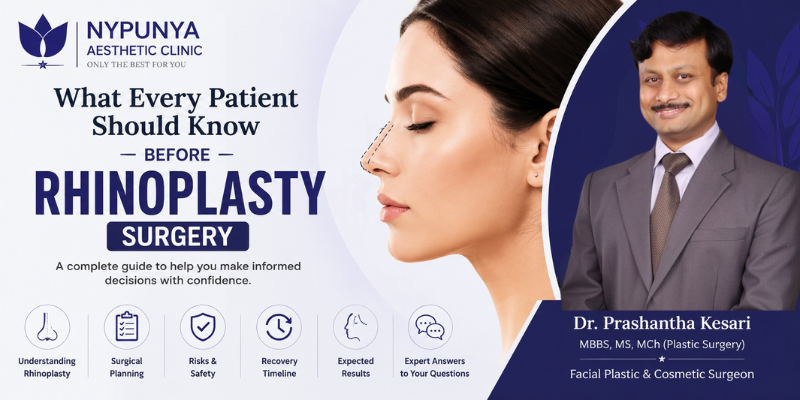
What Every Patient Should Know Before Rhinoplasty Surgery
[By Dr. Prashantha Kesari N.K. | Nypunya Aesthetics Clinic, JP Nagar, Bengaluru ]
Rhinoplasty, commonly called a “nose job,” is a surgical procedure that reshapes the nose to improve its appearance, correct breathing problems, or repair damage from injury or birth. It remains one of the most requested facial plastic surgery procedures worldwide because the nose sits at the center of the face and has an outsized effect on facial harmony and confidence. This guide answers the questions patients most often asked based on the surgical philosophy of Dr. Prashantha Kesari: natural-looking results tailored to each patient’s unique bone structure, skin type, and ethnicity, rather than a single “ideal” nose shape.
What Is Rhinoplasty?
Rhinoplasty is a surgery that changes the size, shape, or proportions of the nose by reshaping the underlying bone, cartilage, and sometimes skin. It can be purely cosmetic, purely functional (to improve breathing, as with a deviated septum), or a combination of both. No two noses are corrected the same way, because facial proportions, skin thickness, and ethnic features differ from patient to patient.
Am I a Good Candidate for Rhinoplasty?
Good candidates typically meet the following criteria:
- Facial growth is complete, generally after age 18
- Good general health with no uncontrolled medical conditions
- Realistic expectations about what surgery can achieve
- A specific concern, such as a dorsal hump, wide bridge, bulbous tip, or breathing difficulty
- Psychological readiness to undergo elective surgery and follow recovery instructions
Types of Rhinoplasty
Rhinoplasty is not one procedure but a family of techniques matched to the patient’s goals:
- Cosmetic Rhinoplasty – reshapes the nose for aesthetic balance
- Functional Rhinoplasty – corrects breathing issues such as a deviated septum
- Revision Rhinoplasty – refines the results of a previous surgery
- Ethnic Rhinoplasty – preserves ethnic identity while refining shape
- Open Rhinoplasty – a small external incision gives full visibility for complex reshaping
- Closed Rhinoplasty – all incisions are hidden inside the nostrils, with less visible swelling
Open rhinoplasty is generally preferred for significant structural changes, while closed rhinoplasty suits smaller refinements and offers a faster initial recovery. The right approach depends on the specific concern, not personal preference alone.
How Dr. Prashantha Kesari Plans Your Rhinoplasty
Every rhinoplasty at Nypunya Aesthetics Clinic begins with a detailed facial analysis rather than a fixed template. Dr. Prashantha Kesari evaluates facial proportions, skin thickness, ethnic background, and nasal function together, then uses digital imaging to plan a result that suits the individual’s face rather than a generic aesthetic. The goal is a nose that looks like it always belonged on that face: refined, balanced, and unmistakably natural.
The Rhinoplasty Procedure: Step by Step
On the day of surgery, the patient is given general or local anesthesia with sedation. The surgeon makes incisions (open or closed, depending on the plan), reshapes the cartilage and bone, corrects the septum if needed, and closes the incisions. A splint is placed to protect the new shape while initial healing occurs. The procedure typically takes one and a half to three hours.
Recovery Timeline
- Day 1-2: Swelling and mild discomfort; rest with head elevated
- Week 1: Splint removal; most visible bruising fades
- Week 2: Return to non-strenuous work and social activities
- Month 1-3: Residual swelling reduces steadily; shape becomes clearer
- Month 6-12: Final results emerge as subtle swelling fully resolves
Rhinoplasty Cost in India
Cost varies based on the complexity of the case, whether it is cosmetic, functional, or revision surgery, the surgeon’s experience, the hospital or facility used, and whether structural grafting is required. Rather than choosing based on price alone, patients are advised to weigh the surgeon’s experience, safety record, and consistency of natural-looking results, since revision surgery is more complex and costly than getting it right the first time.
Risks and Safety
As with any surgery, rhinoplasty carries risks including bleeding, infection, swelling, temporary numbness, and, in a small percentage of cases, the need for a minor revision. A thorough consultation, accurate surgical planning, and an experienced surgical team significantly reduce these risks.
Is rhinoplasty painful?
How long does it take to see the final results of rhinoplasty?
Can rhinoplasty improve breathing as well as appearance?
What is the difference between open and closed rhinoplasty?
Is revision rhinoplasty more complex than primary rhinoplasty?
Choosing the Right Plastic Surgeon
Choosing the Right Plastic Surgeon
Selecting a plastic surgeon should involve much more than reviewing photographs or comparing techniques.
Patients should consider:
- Board certification and formal training in Plastic Surgery.
- Experience in performing both functional and aesthetic rhinoplasty.
- A thoughtful consultation that includes a detailed facial and nasal analysis rather than a standard treatment plan.
- An honest discussion about realistic expectations, limitations, risks, and recovery.
- Access to an accredited hospital with appropriate surgical infrastructure and patient safety protocols.
- A surgeon who is comfortable performing open, closed, structural, preservation, and revision rhinoplasty, selecting the technique that best suits the individual patient.
As I often tell my patients:
“Do not choose a surgeon because of the name of the technique. Choose a surgeon who understands the anatomy, has mastered multiple rhinoplasty techniques, and can customize the operation to your nose rather than making every nose fit the same operation.”
This philosophy consistently produces the most natural, functional, and long-lasting outcomes.
Why Choose Nypunya Aesthetics Clinic?
Every rhinoplasty at Nypunya Aesthetics Clinic is planned around the individual, not a fixed template. Dr. Prashantha Kesari combines functional and aesthetic goals in a single surgical plan, prioritizes patient safety through thorough pre-operative assessment, and provides structured long-term follow-up to track healing and final results. The underlying philosophy is facial harmony: a nose that supports breathing and belongs naturally on the patient’s own face, not a borrowed ideal.
About the Author
Dr. Prashantha Kesari N.K. — Senior Cosmetic Plastic Surgeon | M.Ch (Plastic Surgery), DNB, MRCS (Royal College of Surgeons, UK), DMLE, MBBS | Advanced Fellowship in Cosmetic & Laser Surgery | 20+ years of surgical experience | Pioneer of Ultrasonic Rhinoplasty & Endoscopic Scarless Facelift in Bengaluru | National gold medallist | Nypunya Aesthetics Clinic, JP Nagar, Bengaluru.
Disclaimer: This article is for educational and informational purposes only. Individual results and costs vary. Please consult directly with Dr. Prashantha Kesari for a personalised assessment before making any medical decision.

Category
Latest From Blog
Flying Home After Rhinoplasty: Your Complete Travel Timeline
Rhinoplasty Complications: What Happens When Things Change
Beyond the Bandages: 4 Surprising Truths About Facelift Recovery
Popular Tag