

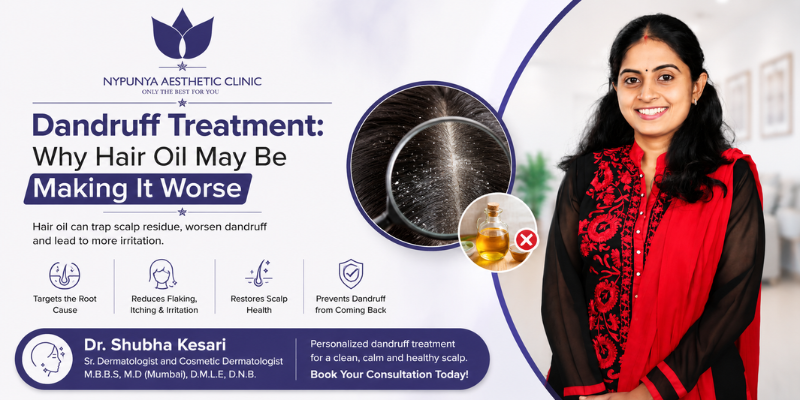
Dandruff Treatment: Why Hair Oil May Be Making It Worse
[By Dr. Shubha Kesari| Sr. Dermatologist and Cosmetic Dermatologist | M.B.B.S, M.D(MUMBAI) D.M.L.E, D.N.B. | Nypunya Aesthetics Clinic, JP Nagar, Bengaluru ]
Our grandmother’s remedy of oiling the hair overnight could actually be one of the reasons your dandruff keeps coming back. It sounds strange, I know — oiling is something we’ve all grown up trusting, something we’ve watched our mothers and grandmothers do for us since childhood. It feels caring, traditional, and safe. But when it comes to dandruff specifically, leaving oil on overnight may be doing more harm than good.
Here’s why: dandruff is not just a dry scalp problem. It’s driven by a fungus called Malassezia that is normally present on the scalp of almost everyone. In small amounts, this fungus is completely harmless and simply lives on your skin without causing any issues. But when the scalp environment becomes favourable for it — warm, oily, and left undisturbed for hours — it starts to grow more, break down the natural oils on your scalp, and trigger the flaking, itching, and irritation we recognise as dandruff.
So Where Does Oil Fit In?
Oil itself isn’t the enemy here. In fact, a good scalp massage improves blood circulation, feels genuinely relaxing, and has real cultural and emotional value for many of us. The problem is when oil is left on the scalp overnight, every single time, as a blanket “cure” for dandruff. Leaving oil on for that many hours creates exactly the warm, undisturbed, moisture-rich environment Malassezia loves to feed on. So instead of calming an irritated scalp, an overnight oil session can quietly feed the very fungus that’s causing the problem in the first place.
This is why oiling has to be restricted — used mindfully, for a short duration, and washed off properly — rather than left on overnight as a blanket fix for every scalp concern. A couple of hours before a wash is a very different practice from an all-night soak under a shower cap, and that difference matters far more than most of us realise.
What Actually Helps
Once you wash the oil off with your shampoo, the real goal is to follow it up with the right kind of cleansing routine — one that controls the fungus, reduces excess oil production, and calms inflammation, rather than one that simply moisturises the scalp further. This is exactly where most home remedies fall short, because they’re built around the assumption that dandruff equals dryness. In reality, persistent dandruff usually needs a far more targeted approach: the right anti-fungal or medicated ingredients, the correct frequency of washing, and sometimes a short course of scalp treatment to bring the scalp back into balance.
This is also why dandruff that doesn’t respond to regular shampoos, or keeps returning within days of a wash, shouldn’t be self-treated indefinitely with one home remedy after another. Persistent flaking, redness, or itching are signals that the scalp needs a proper diagnosis, not another layer of oil, curd, or lemon rubbed in and left overnight.
When to See a Dermatologist
If you’ve already tried oiling, switching shampoos, and various home remedies, and your dandruff simply isn’t settling down, it’s time to get your scalp properly assessed. At Nypunya Aesthetic Clinic, we look closely at what’s actually going on beneath the flakes — oil production levels, fungal load, and any underlying scalp sensitivity or inflammation — before recommending a course of treatment. Depending on what we find, this could mean a customised anti-dandruff regimen, medicated scalp treatments, or in more stubborn, long-standing cases, in-clinic scalp therapies specifically designed to reset the scalp’s natural balance.
The good news is that dandruff, however frustrating and persistent it feels, is very manageable once it’s approached correctly. You don’t need to keep guessing your way through remedies that may quietly be working against you. A proper diagnosis paired with a scalp-specific treatment plan can get you to a flake-free, comfortable scalp far faster — and far more reliably — than another night of oil under a shower cap.
So the next time dandruff flares up, pause before reaching for the oil bottle as your only answer. Ask what your scalp is actually telling you, and treat it accordingly.
Talk to Our Experts Today
If dandruff has been a recurring problem despite your best efforts, let’s take a closer look at your scalp together.

Category
Latest From Blog
Flying Home After Rhinoplasty: Your Complete Travel Timeline
Rhinoplasty Complications: What Happens When Things Change
Beyond the Bandages: 4 Surprising Truths About Facelift Recovery
Popular Tag