

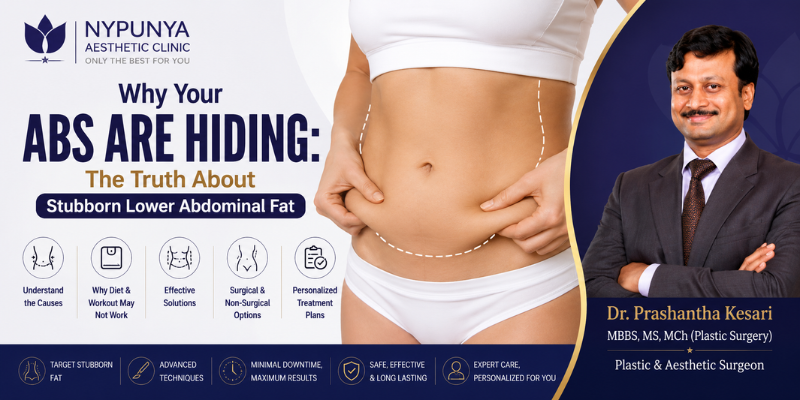
Why Your Abs Are Hiding: The Truth About Stubborn Lower Abdominal Fat
[By Dr. Prashantha Kesari N.K. | Nypunya Aesthetics Clinic, JP Nagar, Bengaluru ]
You’re doing everything right. You haven’t missed a morning session in months, your meal prep is clinical, and your discipline is ironclad. Yet, every time you look in the mirror, there it is: that stubborn “spare tire” or lower belly pooch that refuses to budge. It feels like you’ve hit a wall that no amount of caffeine or willpower can break through.
If you’re wondering why this specific layer of fat is ignoring your maximum effort, you aren’t alone—and more importantly, you aren’t failing. The truth is that you’re likely fighting a battle that wasn’t meant to be won in the weight room.
The Design Gap in Traditional Gym Regimes
We’ve been conditioned to believe that the gym is a universal fix for every physical frustration. But as an aesthetic specialist, I see men every day who are in peak condition yet still carry a localized pocket of fat in the lower abdomen.
We need to stop viewing the gym as a failing tool and start seeing it for what it actually is: a powerhouse for building muscle and improving general metabolic health, but one with specific design boundaries.
“Exercise regime gym was not designed to correct this layer of fat.”
This realization is the ultimate game-changer for the dedicated athlete. When you understand that your routine—regardless of the intensity—was never architected to target this specific physiological layer, the burden of “not trying hard enough” vanishes. This isn’t a failure of character or a lack of grit; it’s a simple mismatch between the tool and the task. By trading personal blame for biological reality, you can stop punishing yourself for results that your gym routine was never designed to deliver.
Why the mismatch happens in the first place: fat distribution is governed largely by genetics and hormonal patterning, not by how many sets you can grind through. Some fat is metabolically “active” and responds readily to a calorie deficit and cardio. Other fat—often the exact pocket sitting low on the abdomen—is stubborn precisely because it is wired differently, with a lower density of the receptors that respond to fat-burning signals during exercise. No amount of extra reps changes that wiring. It’s not a motivation problem; it’s a biology problem, and biology problems need biological solutions.
Body Contouring as a Strategic Reset
In the fitness world, there is often a lingering stigma that any medical intervention is “cheating.” We need to dismantle that myth. If your car has a dent that a car wash can’t fix, you don’t keep washing it harder; you go to a specialist with the right tools.
Body contouring is not a shortcut or a “get out of jail free” card for a lazy lifestyle. It is a precision instrument used to resolve a specific biological limitation that the gym cannot reach.
Think of body contouring as a strategic reset. It is a tactical extension of your existing hard work. By removing the stubborn layer that your genetics have cordoned off from your exercise efforts, you are finally allowing the physique you’ve built underneath to be seen. It’s about clearing the final obstacle so your results finally match your effort.
What this looks like in practice: → You keep training exactly as you already do—nothing about your discipline changes. → The procedure addresses the one variable that discipline alone cannot move: a genetically stubborn fat pocket. → Your existing muscle definition, already built through months of consistent work, becomes visible instead of obscured. → Maintenance stays entirely in your hands, through the same diet and training habits that got you this far.
This is precisely why it should never be framed as replacing effort—it’s the missing piece that lets your effort finally show.
Living a Fulfilling Life Beyond the Frustration
The most significant drain on a fitness journey isn’t the physical fatigue; it’s the mental weight of constant frustration. When you work tirelessly and the mirror doesn’t reflect that effort, it erodes your motivation. Addressing this fat layer is about more than aesthetics—it’s about psychological liberation.
The most effective way to view a body contouring procedure is as a “partner” to your fitness lifestyle. The procedure handles the stubborn biology that is resistant to change, while you handle the maintenance. Once that persistent hurdle is removed, you can happily continue with your diet and exercise regime. You return to the gym without the mental drag of a “plateau,” allowing you to live a more fulfilling life where your fitness routine is a source of pride rather than a source of resentment.
Consider what changes once the frustration lifts: → Training becomes about performance and enjoyment again, not about chasing an area that was never going to respond. → You stop second-guessing your diet every time the mirror doesn’t cooperate. → Confidence stops being conditional on a stubborn inch that was biologically out of reach. → The gym returns to being a place of achievement rather than a scoreboard for a battle you were never going to win unaided.
That shift—from frustration to freedom—is often more transformative than the physical change itself. Men who’ve spent years chasing an unmoving number on the scale or an unmoving inch on the waistline often describe the psychological relief as the bigger win, with the aesthetic result simply confirming what they already knew: the effort was always there, it just needed the right tool to finish the job.
The Future of Your Fitness Journey
True fitness is about more than just the numbers on a scale or the hours spent under a squat rack; it’s about knowing when to pivot. When you recognize that a specific physical trait is functionally resistant to traditional methods, you gain the power to make an informed, tactical decision for your body.
Redefining fitness for its next chapter doesn’t mean abandoning the gym, the meal prep, or the discipline that got you here—it means recognizing where that discipline ends and where precision medicine begins. The strongest, most sustainable fitness journeys aren’t the ones that refuse outside help on principle; they’re the ones that know exactly which tool to reach for at exactly the right moment.
When your traditional methods hit a biological wall, how will you redefine what “fitness” looks like for the next chapter of your journey?
Only The Best For You.

Category
Latest From Blog
Timing Your Tummy Tuck: Surgery and Future Pregnancy
Reclaiming Your Body: The Mommy Makeover Candidate Guide
Quiet Spaces Built on Two Decades of Discreet Care
Popular Tag