

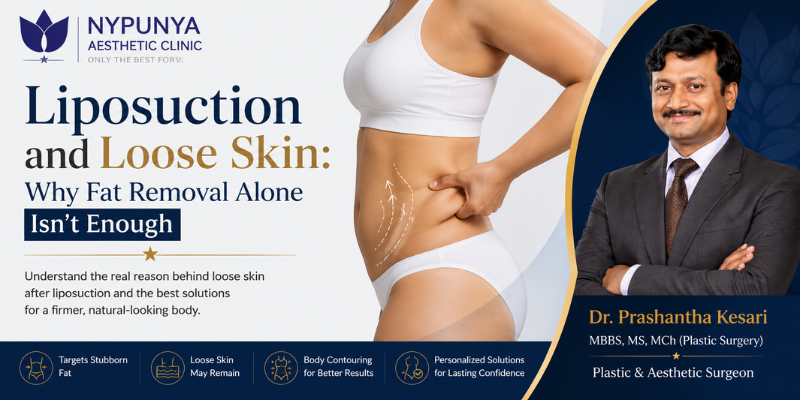
Liposuction and Loose Skin: Why Fat Removal Alone Isn’t Enough
[By Dr. Prashantha Kesari N.K. | Nypunya Aesthetics Clinic, JP Nagar, Bengaluru ]
Introduction: The Post-Lipo Surprise
Imagine looking in the mirror weeks after surgery, expecting to see a sculpted, taut silhouette, only to find that while the fat is gone, your skin remains—sagging like a garment that is two sizes too large. This “post-lipo surprise” is a common frustration for patients who mistake fat removal for a skin-tightening solution.
In reality, reducing volume is only half the battle; the final result depends entirely on your skin’s ability to “snap back” over its new frame. Drawing on the expertise of Dr. Prashantha Kesari, we will explore the science of skin contraction and why your “inherent elasticity” is the ultimate decider of your surgical outcome.
Takeaway 1: Liposuction is a Volume Tool, Not a Surface Tool
Liposuction is an exceptional tool for contouring, but it operates beneath the surface, targeting fat in both the deep and superficial layers. Think of your body like a balloon: if it has been inflated for a long time, simply letting the air out does not return the rubber to its original, taut state.
Removing the fat that was once “expanding” the skin does not guarantee the skin will naturally shrink to fit your smaller proportions.
Skin is an elastic structure and we can take out the fat under it in both deep as well as superficial layers. For the skin to contract when there is nothing expanding it, it will contract as much as its elasticity is inherent and it continues to contract further to the best possible contraction.
Takeaway 2: Your Results are Tethered to Your “Inherent Elasticity”
Once the fat is removed, your skin begins its own biological journey to shrink-wrap around your new contours. However, this process is strictly governed by your “inherent elasticity”—a biological limit determined by genetics, age, and previous stretching. While your skin will attempt to contract to the best of its ability, it cannot exceed these structural boundaries. If the skin’s internal architecture is damaged, it simply won’t have the “bounce” required to reveal the underlying muscle definition.
Reflection: As a patient, the most critical shift occurs during the consultation phase. You must transition from the mindset of “I want this fat gone” to “Is my skin healthy enough to follow this change?” This honest assessment is the bridge between a disappointing outcome and a successful transformation.
Understanding your biological baseline ensures you aren’t chasing a result that your skin is physically incapable of delivering.
Takeaway 3: The Role of Multimodal RF in Speeding Up the Process
While the body performs the majority of the work during recovery, modern aesthetic technology can provide a strategic assist. Multimodal RF (Radio Frequency) is an advanced tool that Dr. Kesari notes can be used to enhance the healing phase.
Its primary purpose is to optimize the “healing contraction,” encouraging the skin to settle into its new position faster than it would through natural processes alone.
Key Insight: Technology like Multimodal RF serves as a recovery accelerator, not a miracle cure. It helps your body reach its best possible contraction more efficiently, but it cannot fix skin that has already lost its fundamental structural integrity.
Takeaway 4: Identifying the “Tuck” Threshold
There is a specific threshold where the skin’s inherent elasticity is no longer sufficient to contract on its own. When this limit is crossed, relying on liposuction alone is a recipe for a poor aesthetic result. In these cases, a “tuck” procedure (such as a tummy tuck) becomes necessary.
Unlike the relatively quick change in volume provided by liposuction, natural skin contraction is a marathon; for damaged skin, that marathon may take a “very, very long time” or never reach the finish line at all.
According to Dr. Kesari, you should look for these visible clinical indicators that a tuck is required:
- The presence of numerous stretch marks, which signal that the skin’s internal elastic fibers are permanently compromised.
- Significant overhanging skin that folds over itself, indicating there is too much surface area for the body to retract naturally.
Conclusion: Managing Expectations for the Best Outcome
Successful body contouring is a partnership between the surgeon’s technical skill and your body’s biological potential. Achieving a truly reshaped silhouette requires more than just a focus on fat volume; it demands a realistic assessment of skin quality.
By distinguishing between volume reduction and skin tightening, you can work with your surgeon to choose the right combination of procedures for your specific needs.
Is your goal simply less volume, or is it a truly reshaped silhouette?
Can liposuction tighten loose skin?
Why does loose skin remain after liposuction?
What determines how much my skin will shrink after liposuction?
How do stretch marks affect liposuction results?
When is a tummy tuck recommended instead of liposuction alone?
Does using rib cartilage affect recovery?
When is a tummy tuck recommended instead of liposuction alone?
How long does skin tightening take after liposuction?
How can I know if my skin is suitable for liposuction?
Is liposuction suitable for everyone with excess fat?
What is the most important factor for achieving natural-looking body contouring results?
Choosing the Right Plastic Surgeon
Selecting a plastic surgeon should involve much more than reviewing photographs or comparing techniques.
Patients should consider:
- Board certification and formal training in Plastic Surgery.
- Experience in performing both functional and aesthetic rhinoplasty.
- A thoughtful consultation that includes a detailed facial and nasal analysis rather than a standard treatment plan.
- An honest discussion about realistic expectations, limitations, risks, and recovery.
- Access to an accredited hospital with appropriate surgical infrastructure and patient safety protocols.
- A surgeon who is comfortable performing open, closed, structural, preservation, and revision rhinoplasty, selecting the technique that best suits the individual patient.
As I often tell my patients:
“Do not choose a surgeon because of the name of the technique. Choose a surgeon who understands the anatomy, has mastered multiple rhinoplasty techniques, and can customize the operation to your nose rather than making every nose fit the same operation.”
This philosophy consistently produces the most natural, functional, and long-lasting outcomes.
Why Choose Nypunya Aesthetics Clinic?
Every rhinoplasty at Nypunya Aesthetics Clinic is planned around the individual, not a fixed template. Dr. Prashantha Kesari combines functional and aesthetic goals in a single surgical plan, prioritizes patient safety through thorough pre-operative assessment, and provides structured long-term follow-up to track healing and final results. The underlying philosophy is facial harmony: a nose that supports breathing and belongs naturally on the patient’s own face, not a borrowed ideal.
About the Author
Dr. Prashantha Kesari N.K. — Senior Cosmetic Plastic Surgeon | M.Ch (Plastic Surgery), DNB, MRCS (Royal College of Surgeons, UK), DMLE, MBBS | Advanced Fellowship in Cosmetic & Laser Surgery | 20+ years of surgical experience | Pioneer of Ultrasonic Rhinoplasty & Endoscopic Scarless Facelift in Bengaluru | National gold medallist | Nypunya Aesthetics Clinic, JP Nagar, Bengaluru.
Disclaimer: This article is for educational and informational purposes only. Individual results and costs vary. Please consult directly with Dr. Prashantha Kesari for a personalised assessment before making any medical decision.

Category
Latest From Blog
Reclaiming Your Body: The Mommy Makeover Candidate Guide
Quiet Spaces Built on Two Decades of Discreet Care
C-Section Belly: Why Does Your Stomach Stay Big After Delivery?
Popular Tag