

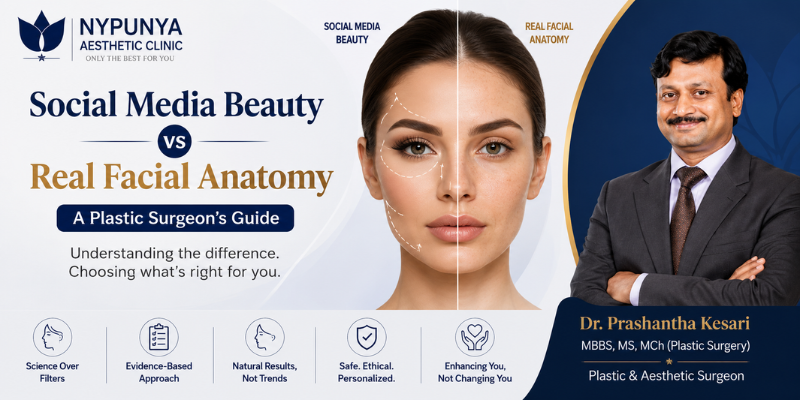
Social Media Beauty vs Real Facial Anatomy: A Plastic Surgeon’s Guide
[By Dr. Prashantha Kesari N.K. | Nypunya Aesthetics Clinic, JP Nagar, Bengaluru ]
- Introduction: The Digital Mirror
We are currently living through a psychological shift in how we perceive the human form. In the age of the “digital mirror,” social media users no longer compare themselves to celebrities; they compare themselves to AI-enhanced, filtered versions of their own faces.
This has created a new, often precarious, reality in the world of cosmetic medicine. Patients now frequently enter surgical consultations clutching smartphones loaded with AI-altered images, expecting a surgeon to replicate a “filter-ready” aesthetic in three dimensions.
However, the chasm between a mobile app and a medical theater is vast. Dr. Prashantha Kesri, a senior cosmetic plastic surgeon at Nipunya Aesthetic Clinic in Bangalore, India, suggests that this trend ignores the fundamental constraints of medical science. To find success in aesthetic enhancement, one must first dismantle the “filter fallacy” and recognize that pixels are not a blueprint for personhood.
- Biology vs. Pixels: The Hard Truth of Human Anatomy
The logic of a smartphone app is one of infinite malleability. A digital file is a collection of data points that can be smoothed, stretched, or liquified with a simple swipe. There is no resistance, no blood supply, and no gravity.
In the operating room, the medium is entirely different. The human face is a complex architecture of bone, muscle, and living tissue. While a slider on an app can reduce a nose or sharpen a jawline in milliseconds, biological structures possess a stubborn integrity that does not respond to digital commands.
Physical tissue has limits. It has a memory and a biological “will” that digital pixels do not. This fundamental reality is why a surgeon cannot simply “copy and paste” an Instagram filter onto a living patient.
“The face is a natural structure. It is not measured in pixels or can’t be altered with a tool. It’s a biological structure. It has life.”
- The “Undo” Button Doesn’t Exist in the OR
The digital culture of “trial and error” has created a dangerous sense of low-stakes experimentation. On an app, a bad edit is fixed with a tap on the “undo” button. In aesthetic surgery, however, the clinician’s first duty is to remind the patient of the weight of permanence.
This biological reality dictates a strict clinical protocol: for Dr. Prashantha Kesri, the response to a patient demanding a pixel-perfect replication of a filter is an “absolute no.” Surgery is deferred—and the planning process halted-until the patient understands that they are altering a living organism, not a static image.
While a filter provides a fleeting dopamine hit of digital perfection, surgery involves months of recovery and permanent anatomical changes. There is no “undo” button in the OR, and any ethical surgical practice must prioritize the long-term health of the biological structure over the short-term satisfaction of a digital fantasy.
- Reference vs. Target: A New Way to Use AI
Despite the risks of the “filter fallacy,” Dr. Prashantha Kesri does not suggest that AI-generated images are without value. Instead, the utility of these tools depends entirely on the patient’s mindset. At Nipunya Aesthetic Clinic, the strategy is to shift the patient’s perspective from viewing the image as a “target” to viewing it as a “guiding tool.”
- The Target Mentality: This is the belief that an AI image is an exact blueprint. This approach is a recipe for clinical failure, as biology can never perfectly mimic a mathematically generated distortion.
- The Reference Mentality: This treats the filtered image as a piece of data to help the surgical team understand a patient’s aesthetic preferences. It serves as a visual language to bridge the gap between patient desire and surgical possibility.
The planning only proceeds when the patient acknowledges the boundary between the digital reference and the biological target.
- Conclusion: The Path to Real Results
The true “wonder” of aesthetic surgery is not found in achieving digital perfection, but in the enhancement of natural, biological beauty. When a patient trades their digital illusions for realistic expectations, a collaborative “Team Effort” begins. By combining the patient’s clear aesthetic goals with the surgical team’s medical expertise, it is possible to achieve extraordinary outcomes.
Ultimately, the most successful results are those that respect the life and structure of the face. As we navigate an increasingly filtered world, we must ask ourselves: Is the goal to look like a manipulated file, or to enhance the living, breathing reality of who we are?
Can plastic surgery make me look exactly like an AI filter or social media edit?
Is it safe to use filtered photos as a reference during a plastic surgery consultation?
Why can't a plastic surgeon recreate an Instagram or Snapchat filter?
What is the difference between a digital image and a surgical result?
Can AI or facial editing apps help plan cosmetic surgery?
Why is having realistic expectations important before cosmetic surgery?
What happens if my expectations are unrealistic?
How can I prepare for a productive cosmetic surgery consultation?
What is the ultimate goal of modern plastic surgery?
Why Choose Nypunya Aesthetics Clinic?
Every rhinoplasty at Nypunya Aesthetics Clinic is planned around the individual, not a fixed template. Dr. Prashantha Kesari combines functional and aesthetic goals in a single surgical plan, prioritizes patient safety through thorough pre-operative assessment, and provides structured long-term follow-up to track healing and final results. The underlying philosophy is facial harmony: a nose that supports breathing and belongs naturally on the patient’s own face, not a borrowed ideal.
About the Author
Dr. Prashantha Kesari N.K. — Senior Cosmetic Plastic Surgeon | M.Ch (Plastic Surgery), DNB, MRCS (Royal College of Surgeons, UK), DMLE, MBBS | Advanced Fellowship in Cosmetic & Laser Surgery | 20+ years of surgical experience | Pioneer of Ultrasonic Rhinoplasty & Endoscopic Scarless Facelift in Bengaluru | National gold medallist | Nypunya Aesthetics Clinic, JP Nagar, Bengaluru.
Disclaimer: This article is for educational and informational purposes only. Individual results and costs vary. Please consult directly with Dr. Prashantha Kesari for a personalised assessment before making any medical decision.

Category
Latest From Blog
How Long Should You Stay in Bangalore Before Returning to the UK After a Facelift?
Moisture vs Hydration: What Does Your Skin Actually Need?
Cosmetic Surgery Ethics: Social Media and New Medical Rules
Popular Tag