

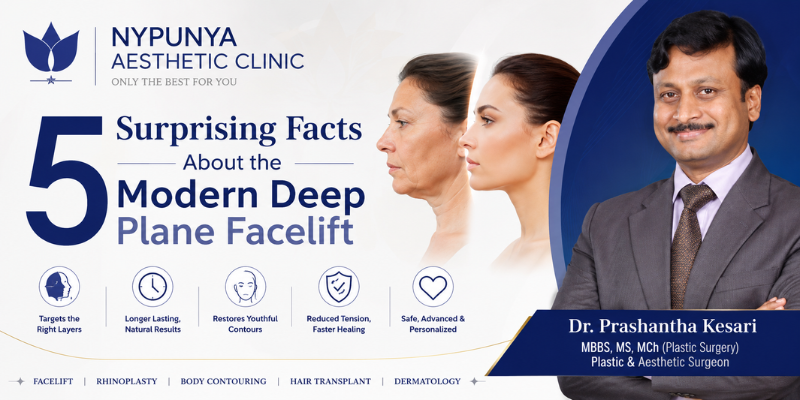
5 Surprising Facts About the Modern Deep Plane Facelift
[By Dr. Prashantha Kesari N.K. | Nypunya Aesthetics Clinic, JP Nagar, Bengaluru | June 2026]
The wind-tunnel stretch. The frozen forehead. The unmistakable ‘I’ve had work done’ look. These are the fears that keep most people away from cosmetic surgery — and rightfully so. But modern facelift surgery, specifically the Deep Plane technique, has fundamentally changed what rejuvenation looks like and what it can achieve.
If you’ve ever placed your hands on your face and gently lifted your cheeks upward in front of a mirror — and recognized a version of yourself from ten or fifteen years ago — you’ve just performed what surgeons call the ‘mirror test.’ What you felt isn’t skin tightening. It’s structural repositioning. And that is precisely what the Deep Plane facelift does.
This article unpacks five truths about the modern Deep Plane facelift that most patients never hear — from why traditional techniques create that ‘operated’ look to how a single four-hour procedure can reset your face by a decade or two.
1. True Rejuvenation Is About Repositioning, Not Tightening
Conventional facelift techniques work primarily at the skin layer — pulling the surface tighter to smooth wrinkles. The problem? Skin is elastic. It stretches, and when it’s stretched beyond its natural tolerance, it looks exactly like what it is: stretched.
The Deep Plane facelift works differently. Rather than pulling the skin, it relocates the entire structural foundation of the face — a layer of muscle and connective tissue called the SMAS (submuscular aponeurotic system) — back to where it sat years ago. The result is a face that looks rested and natural, not operated on.
Think of it this way: if you’ve lived in a house for twenty years and the walls have shifted, you don’t solve it by repainting. You reset the foundations.
The Mirror Test — A Simple Way to Understand Your Face
Stand before a mirror. With your fingertips, gently lift the tissue from your jawline toward your cheekbones. If the person looking back at you is recognisably younger — not different, just younger — that is the goal of the Deep Plane facelift. It restores, not transforms.
2. Anatomy Drives the Procedure — Not Trends
One of the most important things to understand before choosing a surgeon is this: not every face needs the same procedure. In fact, applying the same technique to every patient is one of the most common sources of unnatural-looking results.
At Nypunya Aesthetics, Dr. Prashantha Kesari follows what he calls the ‘Hammer and Nail’ principle:
In Dr. Kesari’s Words “If you have only a hammer, everything looks like a nail. It’s important to have a screwdriver and put a screw when it is necessary, hammer and put a nail when it is necessary.” |
For some patients, the right answer is a non-surgical HIFU treatment or Botox. For others, it might be structural fat grafting without a lift. For those whose tissues have migrated significantly and whose skin has lost elasticity, a Deep Plane facelift is the appropriate tool.
Surgical preparation is equally meticulous. Before any incision is made, the face is precisely mapped — often using ultrasound to identify previous interventions such as old filler deposits or thread lift remnants. This ensures the surgeon is working on a clean, well-understood canvas.
3. The SMAS Layer and Retaining Ligaments: Why Deep Plane Works
What Is the SMAS?
The SMAS is a continuous fibromuscular layer that connects the superficial muscles of the face to the deep structures below. In a conventional facelift, surgeons work on top of this layer or simply tighten it. The Deep Plane approach goes under it — and that distinction makes all the difference.
The Role of Retaining Ligaments
Your face is held in position by a series of retaining ligaments — think of them as ‘pegs’ that anchor tissue to the deeper skeleton. As you age, these pegs hold fast but the tissue between them sags. In a traditional facelift, pulling the skin without releasing these ligaments creates visible tension precisely because you’re fighting the face’s own anchors.
In a Deep Plane facelift, the surgeon releases these ligaments, lifts the entire structural unit as one, and repositions it upward. No fighting. No tension. The skin, freed from needing to do structural work, simply drapes naturally over the repositioned foundation.
Traditional SMAS Facelift | Deep Plane Facelift |
Works above the SMAS layer | Works below the SMAS layer |
Ligaments remain anchored | Ligaments are released |
Skin carries the tension | Deep tissue carries the tension |
Results: 5–8 years typical | Results: up to 20 years |
Risk of ‘pulled’ appearance | Natural repositioning effect |
4. The Scarless Option — It’s Not Just for Older Patients
The Deep Plane facelift has quietly shed its ‘last resort for the elderly’ reputation. A growing number of patients in their late thirties and forties are opting for what is called the ‘scarless’ or minimally-scarred Deep Plane variant — a procedure specifically designed for younger faces.
Who Is the Scarless Variant For?
Patients typically between 35 and 50 years old who still have good skin elasticity but are noticing SMAS migration — a general heaviness in the midface or early jowling — are ideal candidates. Because their skin retains its natural snap-back quality, the surgeon can reposition the deep structural layer without needing to excise any skin. The result is a powerful structural lift with virtually no visible surgical signature.
The Classic Deep Plane: For Those 55 and Above
For patients whose skin has lost elasticity — whether due to age or accelerated sun damage — the conventional Deep Plane facelift remains the gold standard. Here, the surgeon combines deep-tissue repositioning with the artistic trimming of excess skin. Surgical lasers are frequently deployed in the same session to address surface-level sun damage and texture issues, ensuring the skin quality matches the newly repositioned structure beneath it.
Feature | Scarless Deep Plane (35–50) | Classic Deep Plane (55+) |
Primary issue | SMAS migration | SMAS migration + skin laxity |
Skin excision | No | Yes (artistic trimming) |
Scarring | Minimal / hidden | Minimal, hairline & ear-fold |
Laser resurfacing | Optional | Often combined |
Ideal candidate | High skin elasticity | Reduced elasticity |
5. The Dual-Layer Fat Strategy: The Secret to Glowing, Youthful Skin
Repositioning tissue addresses the sag. But ageing is a two-fold problem: volume is lost alongside structure. A face that has been lifted without volume restoration can look tight yet gaunt — ‘windblown but hollow.’ This is why the modern Deep Plane technique integrates a sophisticated fat grafting protocol within the same four-hour surgical window.
Two Types of Fat, Two Distinct Purposes
- Structural Fat Grafting — The surgeon harvests the patient’s own fat (typically from the abdomen or inner thigh) and uses it to rebuild the ‘pillars’ of the face: the cheeks, temples, and under-eye hollows that have become skeletal over time. This restores three-dimensional volume and the soft fullness associated with youth.
- Nano Fat — A refined, ultra-filtered version of harvested fat, Nano fat is not used for volume. Instead, it is injected superficially across the skin’s surface for its regenerative properties. Rich in growth factors and stem cells, Nano fat repairs sun damage, improves skin texture, and restores the natural glow that anti-ageing skincare alone cannot replicate.
Why This Matters for Your Result Structural fat grafting repositions volume lost to ageing. Nano fat treats the skin’s actual quality — texture, luminosity, and resilience. Together, they create a result that looks like a well-rested, younger version of you — not a surgically altered one. |
What to Expect: The Recovery Journey
The Deep Plane technique is designed not just for exceptional results but for a smoother, safer recovery than older facelift methods. A key part of this is the use of tumescent fluid during surgery — a technique that dramatically reduces bleeding by shrinking blood vessels before any incisions are made. Blood loss during a Deep Plane facelift is typically just a few millilitres.
Recovery Timeline
Phase | What to Expect |
Day 0 (Surgery) | Mild grogginess from anaesthesia; slight throat irritation; temporary visual haziness. |
Days 1–3 | Peak swelling; some bruising (especially if Nano fat was used). Avoid head-down positions and any heavy lifting. |
Day 7–9 | Suture removal around ears and hairline. Lines may appear slightly pink — meticulously placed to fade to near-invisibility. |
Weeks 4–8 | Full recovery window. Lymphatic massage is recommended to reduce residual swelling and soften tissue around the ears. |
Month 3 onwards | Final results become fully visible as swelling resolves. The face settles into its new, natural position. |
Key Benefits of the Deep Plane Facelift at a Glance
- Results last up to 20 years — the longest-lasting of any facelift technique
- Natural appearance — no ‘pulled’ or ‘operated’ look
- Preserves blood supply by keeping skin and SMAS connected
- Addresses both structural sag and volume loss in one procedure
- Reduced downtime compared to older facelift methods
- Can be combined with Nano fat for skin regeneration
- Available as a ‘scarless’ variant for patients aged 35–50
What is a Deep Plane facelift?
How long do Deep Plane facelift results last?
What is the difference between a Deep Plane facelift and a SMAS facelift?
Am I too young for a facelift?
What is structural fat grafting and why is it done during a facelift?
What is Nano fat and how is it different from regular fat grafting?
How long does Deep Plane facelift surgery take?
What is the recovery time for a Deep Plane facelift?
Who is the best candidate for a Deep Plane facelift in Bengaluru?
How to Change my Photo from Admin Dashboard?
Can a Deep Plane facelift make me look like a different person?
Ready to Ask These Questions? Book Your Virtual Consultation. |
Senior Cosmetic Plastic Surgeon | M.Ch, MRCS, 20+ Years Experience | JP Nagar, Bengaluru |
Call / WhatsApp: +91 9380902115 | nypunyaaesthetics.com | clinic.nypunyaaesthetic@gmail.com |
About the Author
Dr. Prashantha Kesari N.K. — Senior Cosmetic Plastic Surgeon | M.Ch (Plastic Surgery), DNB, MRCS (Royal College of Surgeons, UK), DMLE, MBBS | Advanced Fellowship in Cosmetic & Laser Surgery | 20+ years of surgical experience | Pioneer of Ultrasonic Rhinoplasty & Endoscopic Scarless Facelift in Bengaluru | National gold medallist | Nypunya Aesthetics Clinic, JP Nagar, Bengaluru.
Disclaimer: This article is for educational and informational purposes only. Individual results and costs vary. Please consult directly with Dr. Prashantha Kesari for a personalised assessment before making any medical decision.

Category
Latest From Blog
Non-Surgical Rhinoplasty: 5 Things Nose Fillers Cannot Fix
How Long Should You Stay in Bangalore Before Returning to the UK After a Facelift?
Moisture vs Hydration: What Does Your Skin Actually Need?
Popular Tag