

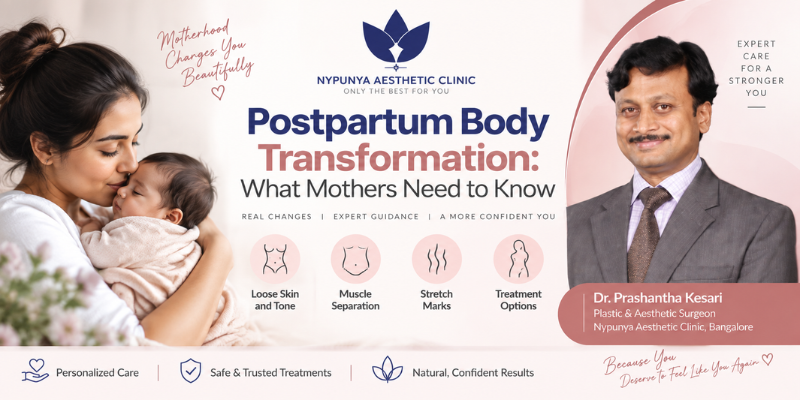
Postpartum Body Transformation: What Mothers Need to Know
[By Dr. Prashantha Kesari N.K. | Nypunya Aesthetics Clinic, JP Nagar, Bengaluru ]
Pregnancy asks a woman’s body to do something extraordinary. Over nine months, it stretches, shifts, and rebuilds itself to grow and deliver a new life. What often gets less attention is what happens next – the months and years afterward, when the body tries to find its way back to balance. According to Dr. Prashantha Kesari, senior cosmetic plastic surgeon at Nypunya Aesthetic Clinic, understanding these changes clearly is the first step toward recovering from them properly.
“So many mothers come to me feeling confused, even a little betrayed, by their own bodies,” says Dr. Kesari. “They did everything right – ate well, exercised, gave their body time – and certain changes are still there. The truth is, some of these changes are structural, not just about effort. Once women understand what’s actually happening inside the body, the path forward becomes much clearer.”
Here is a closer look at the most common postpartum body changes, explained simply, and the treatments that genuinely help — according to Dr. Kesari’s years of surgical experience.
- Stretched and Loose Abdominal Skin
During pregnancy, the skin over the belly stretches significantly to make room for a growing baby. Skin is elastic, but that elasticity has limits. For many women, especially after carrying a larger baby, twins, or multiple pregnancies, the skin does not fully snap back afterward.
“This isn’t a matter of willpower,” Dr. Kesari explains. “Skin elasticity depends heavily on genetics, age, and how much the skin was stretched. Two women can follow the exact same diet and exercise routine and end up with very different results, simply because their skin responded differently to the stretch.”
For milder cases, skin can improve over 12 to 18 months as the body naturally tightens. But when skin remains loose and hangs even after this window, exercise alone cannot fix it — because loose, overstretched skin does not regain its original firmness through muscle strengthening. This is one of the most common reasons women eventually consult Dr. Kesari about surgical options.
- Separated Abdominal Muscles (Diastasis Recti)
Beneath the skin, the two long muscles that run down the front of the abdomen — the rectus abdominis — are connected by a band of connective tissue. As the uterus expands during pregnancy, this band stretches and can separate, a condition known as diastasis recti.
“Almost every pregnant woman experiences some degree of this separation,” says Dr. Kesari. “For many, it resolves on its own or improves significantly with targeted core exercises in the months after delivery. But for a meaningful percentage of women, especially after multiple pregnancies, the gap remains wide even a year or more later.”
This separation isn’t just a cosmetic concern. A significant, unresolved gap can weaken the core’s ability to support the spine and internal organs, sometimes contributing to lower back pain and a persistent “pooch” appearance no amount of sit-ups can flatten. “When the muscles simply won’t come back together on their own, exercise can’t close that gap,” Dr. Kesari notes. “That requires surgical repair.”
- Stubborn Fat Deposits and Body Shape Changes
Pregnancy naturally changes how and where the body stores fat, largely due to hormonal shifts that prepare the body for breastfeeding and future pregnancies. Many women notice that even after returning to their pre-pregnancy weight, fat tends to sit differently — often around the lower belly, hips, and flanks — in a way that feels resistant to diet and exercise.
Dr. Kesari explains that this is a real, documented physiological pattern, not a lack of discipline. “Diet and exercise are essential for overall health, but they cannot always target these specific, stubborn areas. This is where a technique like 4D Liposculpting can help — it’s designed to sculpt and refine areas that don’t respond to lifestyle changes alone, restoring a more balanced, natural body contour.”
Unlike older liposuction methods that simply remove fat, Dr. Kesari’s 4D Liposculpting approach focuses on shaping the body dynamically — accounting for how it looks in motion and in different positions, not just at rest. “The goal isn’t just fat removal. It’s creating natural-looking contours that move and look right, whether a woman is sitting, standing, or active.”
- The Weakened Core and Its Wider Effects
Beyond appearance, the combination of stretched skin, separated muscles, and shifted fat distribution has a real functional impact. Many new mothers report ongoing lower back discomfort, poor posture from months of carrying and feeding a baby, and a core that simply feels “unreliable” compared to before pregnancy.
“People often think of postpartum recovery as purely cosmetic, but it’s really about restoring function as much as form,” Dr. Kesari says. “A strong, intact core isn’t just about how the stomach looks — it protects the spine, supports posture, and affects how confidently a woman can move through daily life with a young child in her arms.”
This is why Dr. Kesari always begins by asking patients not just what they want to look like, but how their body currently feels — where the discomfort is, what movements feel difficult, and how long these issues have persisted.
The Right Treatment for the Right Stage
Dr. Kesari is firm that not every postpartum change needs surgery, and timing matters enormously. He outlines a clear, staged approach for patients:
Stage 1 — The First Year: Let the Body Heal Naturally In the months immediately after delivery, the priority is rest, gentle movement, and time. Hormones are still settling, breastfeeding may still be ongoing, and weight is often still fluctuating. “Operating on a body that hasn’t finished its natural recovery process doesn’t give predictable, lasting results,” Dr. Kesari explains. “I generally recommend waiting until breastfeeding has stopped and weight has been stable for a few months before even discussing surgery.”
Stage 2 — Reassessment: What Has and Hasn’t Resolved Once the body has had genuine time to heal — usually around 8 to 12 months postpartum — Dr. Kesari conducts a thorough evaluation. This includes checking the degree of muscle separation, the condition and elasticity of the abdominal skin, and how fat distribution has settled. “This is the point where we can honestly tell a woman what her body can still achieve on its own, and what it likely cannot.”
Stage 3 — Matching the Treatment to the Problem Based on this evaluation, Dr. Kesari recommends one of a few paths, depending on what’s actually causing the concern:
- If the main issue is stubborn fat with good skin elasticity, 4D Liposculpting alone may be enough to restore a more natural shape.
- If there is significant muscle separation with minimal excess skin, a more targeted muscle repair may be the right approach.
- If a woman has loose, excess skin along with separated muscles — the most common combination after pregnancy — a full tummy tuck is typically needed, since it addresses both the skin and the muscle layer together, often combined with liposculpting for the most refined result.
“There’s no single answer for every woman,” he emphasizes. “The right treatment depends entirely on what your specific body is dealing with — and that can only be determined through a proper, individual assessment.”
Setting Realistic, Honest Expectations
Dr. Kesari is careful to stress that surgery is not a replacement for a healthy lifestyle, nor is it a guarantee of perfection. “These procedures repair structural changes that exercise and diet genuinely cannot fix on their own. But they work best on a body that is already at a stable, healthy weight. Surgery restores what pregnancy has structurally changed — it doesn’t substitute for overall fitness and wellbeing.”
He also encourages patience with the recovery process itself. Healing from a tummy tuck or liposculpting procedure takes several weeks, with full results visible over a few months as swelling resolves and the body settles into its new shape.
A Body That Has Earned Understanding, Not Judgment
Above all, Dr. Kesari wants mothers to approach these changes with knowledge rather than frustration. “A woman’s body goes through a genuine physical transformation to bring a child into the world. Understanding exactly what changed — the skin, the muscles, the fat distribution — takes away the guesswork and the self-blame. From there, she can make an informed choice: continue healing naturally, or seek a targeted treatment, with full clarity about what each path can realistically offer.”
For the many mothers who reach out to him months or even years after delivery, still working out why their body hasn’t “bounced back,” Dr. Kesari’s message is consistent: the changes are real, they are explainable, and in most cases, there is a clear, honest path toward addressing them — on her own terms, and at her own pace.
1. Why does my abdomen still look different after pregnancy, even after losing weight?
2. Can loose abdominal skin tighten naturally after childbirth?
3. What is diastasis recti, and can it be corrected without surgery?
4. Why do I still have stubborn fat around my lower abdomen, hips, and flanks after pregnancy?
5. What is 4D Liposculpting, and how can it help postpartum mothers
6. When should I consider a tummy tuck after pregnancy?
7. Can a tummy tuck correct both loose skin and separated abdominal muscles?
8. Is liposculpting alone enough, or do I need a tummy tuck?
9. Can postpartum body-contouring surgery improve abdominal function as well as appearance?
10. What should I expect during recovery after a tummy tuck or liposculpting?
Choosing the Right Plastic Surgeon
Selecting a plastic surgeon should involve much more than reviewing photographs or comparing techniques.
Patients should consider:
- Board certification and formal training in Plastic Surgery.
- Experience in performing both functional and aesthetic rhinoplasty.
- A thoughtful consultation that includes a detailed facial and nasal analysis rather than a standard treatment plan.
- An honest discussion about realistic expectations, limitations, risks, and recovery.
- Access to an accredited hospital with appropriate surgical infrastructure and patient safety protocols.
- A surgeon who is comfortable performing open, closed, structural, preservation, and revision rhinoplasty, selecting the technique that best suits the individual patient.
As I often tell my patients:
“Do not choose a surgeon because of the name of the technique. Choose a surgeon who understands the anatomy, has mastered multiple rhinoplasty techniques, and can customize the operation to your nose rather than making every nose fit the same operation.”
This philosophy consistently produces the most natural, functional, and long-lasting outcomes.
Why Choose Nypunya Aesthetics Clinic?
Every rhinoplasty at Nypunya Aesthetics Clinic is planned around the individual, not a fixed template. Dr. Prashantha Kesari combines functional and aesthetic goals in a single surgical plan, prioritizes patient safety through thorough pre-operative assessment, and provides structured long-term follow-up to track healing and final results. The underlying philosophy is facial harmony: a nose that supports breathing and belongs naturally on the patient’s own face, not a borrowed ideal.
About the Author
Dr. Prashantha Kesari N.K. — Senior Cosmetic Plastic Surgeon | M.Ch (Plastic Surgery), DNB, MRCS (Royal College of Surgeons, UK), DMLE, MBBS | Advanced Fellowship in Cosmetic & Laser Surgery | 20+ years of surgical experience | Pioneer of Ultrasonic Rhinoplasty & Endoscopic Scarless Facelift in Bengaluru | National gold medallist | Nypunya Aesthetics Clinic, JP Nagar, Bengaluru.
Disclaimer: This article is for educational and informational purposes only. Individual results and costs vary. Please consult directly with Dr. Prashantha Kesari for a personalised assessment before making any medical decision.

Category
Latest From Blog
Breast Changes After Childbirth: What Mothers Need to Know
Postpartum Body Transformation: What Mothers Need to Know
Postpartum Stretch Marks and Tummy Tuck: What Mothers Need to Know
Popular Tag