

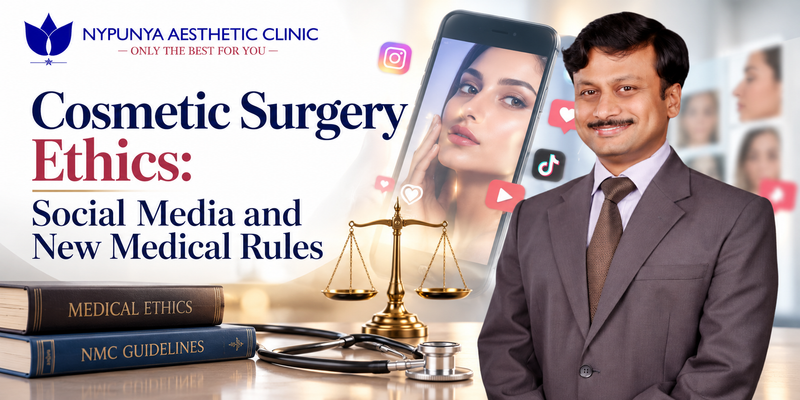
The Social Media Trap in Cosmetic Surgery: 5 Surprising Reasons Why New Medical Rules Are Changing Everything
[By Dr. Prashantha Kesari N.K. | Nypunya Aesthetics Clinic, JP Nagar, Bengaluru ]
- Introduction: The High-Stakes Illusion of Digital Healthcare
In an era dominated by algorithmic prestige, smartphones have quietly transformed into primary healthcare decision engines. Scroll through any major social media platform, and you will find an endless stream of sleek aesthetic center campaigns: high-definition “before and after” reveals, ring-lit consultation rooms, and charismatic influencers touting seamless transformations. Yet, beneath this polished digital veneer lies an alarming and systemic healthcare vulnerability. Every year, countless highly educated consumers are lured into undergoing invasive cosmetic procedures based on social media aesthetics rather than verified medical expertise—only to suffer devastating, botched outcomes requiring complex revision and “redo” surgeries.
When these patients arrive at specialized corrective clinics, doctors encounter a jarring conflict: individuals facing severe surgical complications routinely have no idea who actually operated on them, what specific clinic performed the procedure, or whether the practitioner had any formal surgical credentials. In response to this dangerous accountability void, the National Medical Commission (NMC/NMCA) has introduced decisive regulatory mandates enforcing absolute qualification display. This landmark policy shift aims to dismantle the digital illusions masking healthcare delivery and restore fundamental patient safety.
- Takeaway 1: High-Gloss Profiles Are Hiding a Dangerous Transparency Gap
Social media aesthetics are routinely mistaken for clinical excellence. The modern consumer operating environment is heavily influenced by a psychological “halo effect,” where high visual production value is subconsciously conflated with technical competence. When an aesthetic center boasts millions of views, a verified badge, and ultra-slick video editing, prospective patients instinctively assume the facility operates under the highest medical standards.
In an ecosystem where algorithmic reach replaces traditional clinical vetting, this reliance on digital prestige creates a dangerous blindspot. Marketing metrics like subscriber counts and viral engagement act as a powerful smokescreen, masking a fundamental absence of verified surgical credentials. Even discerning, highly educated professionals routinely succumb to this digital trap, allowing curated visual appeal to obscure basic healthcare due diligence. When glossy branding replaces objective medical evaluation, patients unknowingly forfeit their right to transparency and expose themselves to severe clinical risks at the hands of unverified practitioners.
- Takeaway 2: The “Anonymous Surgeon” Pattern in Redo Surgeries
Corrective surgery specialists encounter a shocking reality among patients seeking help. When cosmetic interventions fail, patients are forced to seek out senior specialists to reconstruct damaged tissue and repair botched results. During initial intake consultations for these high-stakes corrective procedures, reconstructive surgeons consistently report a startling, recurrent pattern: patients are completely unable to provide basic facts about their primary operation.
- Unidentifiable Practitioners: Patients frequently cannot provide the full name or primary specialty of the doctor who performed their initial surgery.
- Obscured Facilities: Patients often know only the marketing moniker of a corporate clinic chain or aggregator app, rather than the registered physical facility where the procedure took place.
- Unverified Competence: Patients are unable to confirm if the individual wielding the scalpel possessed formal board certifications in plastic and reconstructive surgery.
This pervasive anonymity is driven by modern market practices, including healthcare aggregator platforms assigning unvetted providers, corporate clinic brands masking individual practitioner identities behind aggressive marketing, the practice of “ghost operating” (where a senior figurehead signs the consent form but delegates the operation to undertrained personnel), and the delegation of invasive maneuvers to non-surgical technicians. When individual accountability is erased by commercial obscurity, consumer safety collapses.
- Takeaway 3: 13 to 14 Years—The Immense Rigor Behind True Surgical Mastery
True surgical expertise requires over a decade of continuous, specialized medical training. There is a profound, non-negotiable divide between fully qualified surgical specialists and unverified practitioners offering invasive aesthetic procedures. To become a legitimate cosmetic plastic surgeon, a doctor must commit to 13 to 14 years of rigorous education and clinical training.
This extensive educational pipeline is structured to ensure absolute patient safety:
- Basic Medical Degree (MBBS): 5.5 years of foundational medical education, clinical rotations, and basic surgical theory.
- General Surgery Residency (MS/DNB): 3 years of intense, hands-on general surgical residency mastering acute care, tissue management, and core surgical principles.
- Super-Specialization (MCh/DNB) & Fellowships: 3 to 5 years of hyper-focused training dedicated entirely to Plastic, Reconstructive, and Aesthetic Surgery.
This extensive preparation represents earning surgical credentials “the right royal way.” Over this 14-year journey, a surgeon does not merely learn how to execute an aesthetic incision; they master delicate human anatomy, complex reconstructive techniques, and the critical clinical judgment required to navigate life-threatening surgical complications. Contrasting this immense preparation with unverified practitioners who perform invasive operations after taking brief weekend workshops or online certificate courses underscores the profound risk consumers assume when relying on unverified claims.
- Takeaway 4: The NMC Mandate Forces Transparency Back into Healthcare
Decisive regulatory interventions empower consumers with verifiable medical data. To eliminate the opacity polluting the cosmetic healthcare market, the National Medical Commission (NMC/NMCA) has instituted a mandatory disclosure framework. Under these regulatory rules, all practicing medical professionals must explicitly display their official medical qualifications, degree titles, and official medical council registration numbers across physical consultation offices, official websites, and promotional channels.
This enforcement mechanism represents a landmark advance for patient protection:
- Direct Verification: It bridges practitioner claims directly to public medical registries, allowing patients to instantly verify whether a doctor possesses genuine plastic surgery degrees.
- True Informed Consent: It guarantees that patients have clear, unadulterated access to a practitioner’s verified educational background before consenting to treatment or entering an operating room.
- Eradication of Deceptive Titles: It prevents non-surgical practitioners from utilizing vague, misleading terms like “cosmetologist” or “aesthetic specialist” to imply surgical qualifications they do not possess.
- Takeaway 5: Hiding Credentials Speaks Volumes—What Silence Really Means
A practitioner’s willingness to display qualifications reveals their professional legitimacy. Veteran surgeons who have devoted nearly a decade and a half to mastering their craft view regulatory transparency not as a burden, but as a welcome standard. Legitimate experts openly embrace the mandatory display rule, with leading plastic surgeons confirming, “I welcome that move.” For a fully qualified specialist, displaying official credentials is a source of immense professional pride and an assurance of safety to the public.
Conversely, when a practitioner omits, hides, or obscures their formal qualifications, that silence is deeply telling. In the medical domain, a lack of transparency is rarely an oversight; it is an indicator of underlying credential deficiencies. As a veteran cosmetic plastic surgeon incisively notes regarding practitioners who fail to disclose their formal training:
“If they’re not displaying that only means that they’re not proud of what they are.”
- Conclusion: Taking Charge of Your Medical Choices
Navigating the contemporary cosmetic landscape requires looking beyond the hypnotic pull of social media feeds, viral marketing, and ring-lit aesthetics. The National Medical Commission’s transparency mandate equips consumers with the regulatory foundation needed to demand complete, uncompromising medical accountability. Your health, physical safety, and long-term well-being are far too valuable to surrender to algorithmic illusions or anonymous practitioners.
Before you schedule your next consultation or step into an operating room, take charge of your health and ask yourself: Do you truly know the qualifications—and the actual surgeon—behind the scalpel?
1. Why should I verify a plastic surgeon’s qualifications before cosmetic surgery?
2. How can I check whether a plastic surgeon is qualified in India?
3. Can social media popularity guarantee that a cosmetic surgeon is qualified?
4. What qualifications should a plastic surgeon have in India?
5. What are the risks of choosing a cosmetic surgeon based only on social media?
6. Why do some patients need revision or corrective cosmetic surgery?
7. What is informed consent in cosmetic surgery?
8. Why is it important to know which surgeon will perform my operation?
9. Do doctors have to display their qualifications and registration numbers under NMC rules?
10. What questions should I ask before booking cosmetic surgery?
Choosing the Right Plastic Surgeon
Selecting a plastic surgeon should involve much more than reviewing photographs or comparing techniques.
Patients should consider:
- Board certification and formal training in Plastic Surgery.
- Experience in performing both functional and aesthetic rhinoplasty.
- A thoughtful consultation that includes a detailed facial and nasal analysis rather than a standard treatment plan.
- An honest discussion about realistic expectations, limitations, risks, and recovery.
- Access to an accredited hospital with appropriate surgical infrastructure and patient safety protocols.
- A surgeon who is comfortable performing open, closed, structural, preservation, and revision rhinoplasty, selecting the technique that best suits the individual patient.
As I often tell my patients:
“Do not choose a surgeon because of the name of the technique. Choose a surgeon who understands the anatomy, has mastered multiple rhinoplasty techniques, and can customize the operation to your nose rather than making every nose fit the same operation.”
This philosophy consistently produces the most natural, functional, and long-lasting outcomes.
Why Choose Nypunya Aesthetics Clinic?
Every rhinoplasty at Nypunya Aesthetics Clinic is planned around the individual, not a fixed template. Dr. Prashantha Kesari combines functional and aesthetic goals in a single surgical plan, prioritizes patient safety through thorough pre-operative assessment, and provides structured long-term follow-up to track healing and final results. The underlying philosophy is facial harmony: a nose that supports breathing and belongs naturally on the patient’s own face, not a borrowed ideal.
About the Author
Dr. Prashantha Kesari N.K. — Senior Cosmetic Plastic Surgeon | M.Ch (Plastic Surgery), DNB, MRCS (Royal College of Surgeons, UK), DMLE, MBBS | Advanced Fellowship in Cosmetic & Laser Surgery | 20+ years of surgical experience | Pioneer of Ultrasonic Rhinoplasty & Endoscopic Scarless Facelift in Bengaluru | National gold medallist | Nypunya Aesthetics Clinic, JP Nagar, Bengaluru.
Disclaimer: This article is for educational and informational purposes only. Individual results and costs vary. Please consult directly with Dr. Prashantha Kesari for a personalised assessment before making any medical decision.

Category
Latest From Blog
Moisture vs Hydration: What Does Your Skin Actually Need?
Cosmetic Surgery Ethics: Social Media and New Medical Rules
The Ethics of Surgical Excellence and Professional Confidence
Popular Tag