

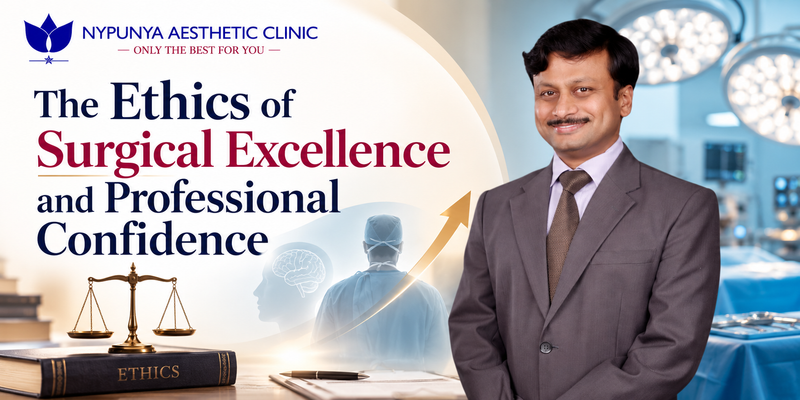
The Ethics of Surgical Excellence and Professional Confidence
[By Dr. Prashantha Kesari N.K. | Nypunya Aesthetics Clinic, JP Nagar, Bengaluru ]
When facing a daunting medical diagnosis or contemplating surgery, patients occupy a uniquely vulnerable position. Driven by natural anxiety and a desperate need for reassurance, it is easy to be drawn toward practitioners who publicly brand themselves as “the best” or “number one.” Yet, as regulatory bodies like the National Medical Commission (NMC) enact stricter guidelines against deceptive medical self-promotion, a stark ethical reality comes to light: healthcare is not a competitive sport.
In truth, loud declarations of clinical pre-eminence often reveal professional insecurity rather than mastery. Examining this phenomenon through the lens of medical ethics demonstrates why the most trustworthy specialists offer professional humility and unwavering dedication rather than grandiose commercial claims.
Takeaway 1: Why Claiming “Number One” Signals Insecurity, Not Superiority
In an era where healthcare marketing increasingly mimics corporate advertising, claims like “the best surgeon” or “unrivaled results” have become alarmingly common. Ethically, this bravado exploits patient vulnerability and compromises informed consent by promising outcomes that no practitioner can guarantee. Healing is fundamentally distinct from competitive athletics or commercial manufacturing; it lacks head-to-head racing conditions, objective ranking algorithms, or standardized parameters to rank one specialist definitively above all peers.
When a clinician resorts to superlative self-promotion, it typically reflects personal uncertainty or commercial anxiety rather than factual supremacy. True clinical mastery recognizes the immense complexity of human biology and respects the equal competence of dedicated colleagues. As one veteran plastic surgeon candidly observed regarding these arrogant claims:
“mentioning that I am number one for this, I am the best for this and nobody else can do like this. This only speaks of insecurity of a surgeon or the medical professional and nobody can claim that he is the best in that field because there is no actual competition and there are no parameters to judge.”
Takeaway 2: The Real Promise—Shifting from “I Am the Best” to “I Will Give My Best”
Ethical medical practice replaces promotional arrogance with a solemn duty of care. While no practitioner can ethically promise an infallible result, they can offer a solemn pledge of complete professional devotion. The profound shift from claiming “I am the best” to promising “I will give my best” transforms the doctor-patient relationship from a transactional pitch into a sacred moral covenant.
This covenant is grounded in rigorous preparation rather than superficial marketing. Achieving high-level surgical competency demands extraordinary personal sacrifice—spending decades in premier academic institutions, surrendering one’s youth, and enduring exhausting physical and mental demands to refine complex skills. An ethical practitioner’s true authority rests on offering this lifetime of training as an absolute, maximal effort for every individual under their care:
“I have trained myself for two decades in the best of the institute I have given my youth day, night, blood, sweat, everything to become the plastic surgeon I am and I will sincerely give my best effort.”
Takeaway 3: Re-interpreting the Tagline—”Only the Best for You”
The balance between patient communication and medical ethics is clearly illustrated in organizational branding. For instance, the guiding tagline adopted by Nuna—“Only the Best for You”—must be understood not as a boastful assertion of market dominance, but as a foundational commitment to patient welfare.
When framed by sound medical ethics, delivering “the best” shifts the focus entirely away from the practitioner’s ego and places it squarely on the patient’s care. It represents an internal oath that every clinical decision, surgical maneuver, and post-operative protocol will be executed with unyielding precision and empathy. Genuine authority in healthcare does not rely on self-aggrandizement; it quietly manifests through clinical integrity, scientific rigor, and deep respect for patient trust.
Conclusion: A Thought-Provoking Reflection on Medical Trust
As regulatory frameworks evolve to protect patients from misleading healthcare claims, we are challenged to rethink how we evaluate true expertise. Medical authority does not reside in marketing superlatives or self-proclaimed titles. Instead, it is expressed through professional modesty, high ethical standards, and an unshakeable commitment to non-maleficence. When placing your health and life in a specialist’s hands, will you seek the illusory comfort of a doctor who claims no one else compares, or will you choose the quiet strength of a clinician whose only promise is a wholehearted devotion to giving their absolute best for you?
1. Why should patients be cautious of doctors who claim to be “the best” or “number one”?
2. Can a plastic surgeon guarantee surgical results?
3. What is the difference between “I am the best” and “I will give my best” in medical practice?
4. What role does medical ethics play in plastic surgery?
5. What should patients look for when choosing a plastic surgeon?
6. Why is informed consent important before cosmetic or plastic surgery?
7. Does a surgeon’s confidence mean they can promise better results?
8. How does a surgeon’s training contribute to surgical excellence?
9. What does “Only the Best for You” mean in the context of medical ethics?
10. How can patients identify misleading medical advertising?
Choosing the Right Plastic Surgeon
Selecting a plastic surgeon should involve much more than reviewing photographs or comparing techniques.
Patients should consider:
- Board certification and formal training in Plastic Surgery.
- Experience in performing both functional and aesthetic rhinoplasty.
- A thoughtful consultation that includes a detailed facial and nasal analysis rather than a standard treatment plan.
- An honest discussion about realistic expectations, limitations, risks, and recovery.
- Access to an accredited hospital with appropriate surgical infrastructure and patient safety protocols.
- A surgeon who is comfortable performing open, closed, structural, preservation, and revision rhinoplasty, selecting the technique that best suits the individual patient.
As I often tell my patients:
“Do not choose a surgeon because of the name of the technique. Choose a surgeon who understands the anatomy, has mastered multiple rhinoplasty techniques, and can customize the operation to your nose rather than making every nose fit the same operation.”
This philosophy consistently produces the most natural, functional, and long-lasting outcomes.
Why Choose Nypunya Aesthetics Clinic?
Every rhinoplasty at Nypunya Aesthetics Clinic is planned around the individual, not a fixed template. Dr. Prashantha Kesari combines functional and aesthetic goals in a single surgical plan, prioritizes patient safety through thorough pre-operative assessment, and provides structured long-term follow-up to track healing and final results. The underlying philosophy is facial harmony: a nose that supports breathing and belongs naturally on the patient’s own face, not a borrowed ideal.
About the Author
Dr. Prashantha Kesari N.K. — Senior Cosmetic Plastic Surgeon | M.Ch (Plastic Surgery), DNB, MRCS (Royal College of Surgeons, UK), DMLE, MBBS | Advanced Fellowship in Cosmetic & Laser Surgery | 20+ years of surgical experience | Pioneer of Ultrasonic Rhinoplasty & Endoscopic Scarless Facelift in Bengaluru | National gold medallist | Nypunya Aesthetics Clinic, JP Nagar, Bengaluru.
Disclaimer: This article is for educational and informational purposes only. Individual results and costs vary. Please consult directly with Dr. Prashantha Kesari for a personalised assessment before making any medical decision.

Category
Latest From Blog
Cosmetic Surgery Ethics: Social Media and New Medical Rules
The Ethics of Surgical Excellence and Professional Confidence
NMC 2026 & Medical Ethics: Why Results Cannot Be Guaranteed
Popular Tag