

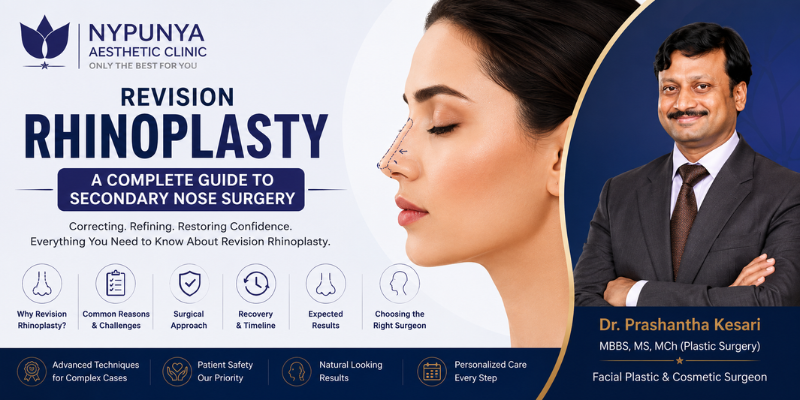
Revision Rhinoplasty: A Complete Guide to Secondary Nose Surgery
[By Dr. Prashantha Kesari N.K. | Nypunya Aesthetics Clinic, JP Nagar, Bengaluru ]
- Introduction: The Quest for the Perfect Profile
Few experiences in aesthetic medicine are as heavy with expectation-or as fraught with vulnerability-as the decision to undergo a revision rhinoplasty. When an initial procedure fails to deliver the intended aesthetic or functional result, the patient often feels a profound sense of uncertainty regarding their anatomical landscape.
However, as a consultant in this field, I can assure you that a secondary procedure is not a mark of failure; it is a sophisticated technical and emotional progression.
While the surgical environment of a “redo” is undeniably more complex, there is a specialized path forward that transforms past disappointment into a realized vision through expert partnership and advanced reconstruction.
- The “5% Rule”: Why Even Experts Return to the Operating Room
In the most elite, high-volume surgical centers, the statistical reality is that approximately 5% of patients will require a revision. This “5% Rule” is not necessarily a reflection of a surgeon’s skill, but rather an acknowledgment of the intricacies of human healing. Often, a revision is initiated because either the patient or the surgeon feels the final result has not yet reached the pinnacle of what was planned. It is a commitment to finishing what was started.
“Rhinoplasty is a journey between the patient and the surgeon.” — Dr. Kesari
This statistic should provide immense reassurance. It underscores a surgeon’s professional dedication to the patient’s long-term satisfaction. Rather than viewing a revision as a setback, we frame it as a necessary course correction to achieve the originally intended goal. It is the definitive act of a partnership that refuses to settle for “good enough.”
- The Septum: Why the “Gold Standard” is Often Gone
The “Missing Wall” and Compromised Structural Integrity
The primary challenge of secondary surgery lies in the depletion of “raw materials.” In a primary rhinoplasty, the septum-the wall of cartilage dividing the nostrils-serves as the surgeon’s “lumber yard,” providing the necessary grafts to shape the nose. In a revision, this gold standard resource is often already exhausted or significantly diminished.
Furthermore, the nasal framework has been altered; tissues are often heavily scarred (fibrotic) and their inherent strength is weakened. This lack of internal support creates a vacuum where a surgeon must find new ways to restore structural integrity to a fragile environment.
- The Rib Cartilage Pivot: A Surprising Statistical Shift
When the septum is no longer a viable source for reconstruction, the surgical strategy must pivot. This is the most significant technical departure from a primary procedure: the shift toward using rib cartilage.
Statistical data reveals that in 50% to 60% of revision cases, rib cartilage is required to achieve a successful outcome. This is not merely an alternative; it is a necessity for structural survival. Because the existing nasal tissues are scarred and weakened, rib cartilage provides a more robust, “industrial-strength” support than what remains of the septum or even softer ear cartilage.
While this necessitates a secondary donor site and incision, the trade off is essential. It provides the surgeon with the required volume of material to restore the desired aesthetics while ensuring the nasal framework is strong enough to maintain a functional airway for a lifetime.
- Conclusion: Beyond the First Cut
Revision rhinoplasty is a highly specialized discipline that demands a different mindset and a different set of materials than a primary surgery. It is a journey of reconstruction that moves beyond the surface, requiring a deep understanding of structural integrity and the patience to navigate a complex anatomical history.
As you consider the path forward, it is worth reflecting on the nature of clinical success: Is true surgical “perfection” defined by the absence of a second cut, or is it found in the unwavering partnership between a patient and a surgeon who are both committed to doing whatever it takes to reach the intended goal?
What is revision rhinoplasty?
Is revision rhinoplasty common?
Why is revision rhinoplasty more complex than the first surgery?
Why is septal cartilage often unavailable during revision rhinoplasty?
Why is rib cartilage frequently used in revision rhinoplasty?
Does using rib cartilage affect recovery?
Can revision rhinoplasty improve breathing as well as appearance?
How long should I wait before considering revision rhinoplasty?
How do I choose the right surgeon for revision rhinoplasty?
Choosing the Right Plastic Surgeon
Selecting a plastic surgeon should involve much more than reviewing photographs or comparing techniques.
Patients should consider:
- Board certification and formal training in Plastic Surgery.
- Experience in performing both functional and aesthetic rhinoplasty.
- A thoughtful consultation that includes a detailed facial and nasal analysis rather than a standard treatment plan.
- An honest discussion about realistic expectations, limitations, risks, and recovery.
- Access to an accredited hospital with appropriate surgical infrastructure and patient safety protocols.
- A surgeon who is comfortable performing open, closed, structural, preservation, and revision rhinoplasty, selecting the technique that best suits the individual patient.
As I often tell my patients:
“Do not choose a surgeon because of the name of the technique. Choose a surgeon who understands the anatomy, has mastered multiple rhinoplasty techniques, and can customize the operation to your nose rather than making every nose fit the same operation.”
This philosophy consistently produces the most natural, functional, and long-lasting outcomes.
Why Choose Nypunya Aesthetics Clinic?
Every rhinoplasty at Nypunya Aesthetics Clinic is planned around the individual, not a fixed template. Dr. Prashantha Kesari combines functional and aesthetic goals in a single surgical plan, prioritizes patient safety through thorough pre-operative assessment, and provides structured long-term follow-up to track healing and final results. The underlying philosophy is facial harmony: a nose that supports breathing and belongs naturally on the patient’s own face, not a borrowed ideal.
About the Author
Dr. Prashantha Kesari N.K. — Senior Cosmetic Plastic Surgeon | M.Ch (Plastic Surgery), DNB, MRCS (Royal College of Surgeons, UK), DMLE, MBBS | Advanced Fellowship in Cosmetic & Laser Surgery | 20+ years of surgical experience | Pioneer of Ultrasonic Rhinoplasty & Endoscopic Scarless Facelift in Bengaluru | National gold medallist | Nypunya Aesthetics Clinic, JP Nagar, Bengaluru.
Disclaimer: This article is for educational and informational purposes only. Individual results and costs vary. Please consult directly with Dr. Prashantha Kesari for a personalised assessment before making any medical decision.

Category
Latest From Blog
Reclaiming Your Body: The Mommy Makeover Candidate Guide
Quiet Spaces Built on Two Decades of Discreet Care
C-Section Belly: Why Does Your Stomach Stay Big After Delivery?
Popular Tag