

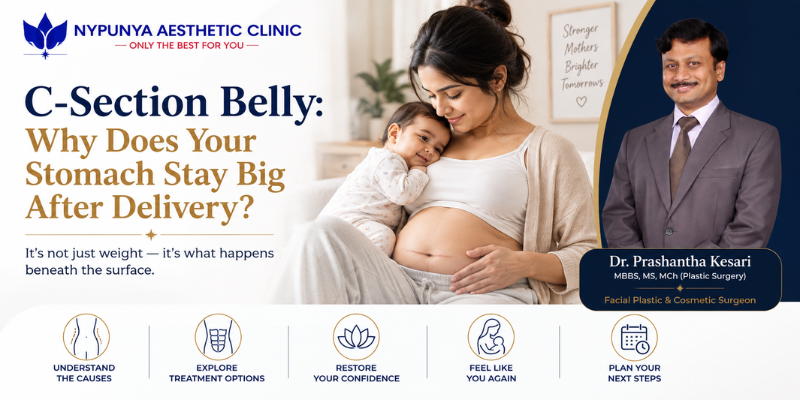
C-Section Belly: Why Does Your Stomach Stay Big After Delivery?
[By Dr. Prashantha Kesari N.K. | Nypunya Aesthetics Clinic, JP Nagar, Bengaluru ]
For many new mothers, the joy of welcoming a baby often comes with an unexpected concern: months after a Caesarean section, the stomach still looks rounded, soft, or “pouchy” — almost as if the pregnancy never fully ended. This is one of the most common post-delivery worries women bring up, and it’s completely valid. Understanding why this happens is the first step toward knowing what can actually be done about it.
It’s Not Just “Extra Weight”
A lot of women assume a persistent belly bulge after a C-section is simply leftover baby weight that hasn’t been shed yet. While weight retention does play a role, it’s rarely the whole story. In most cases, the stubborn belly is the result of a combination of physical changes that diet and exercise alone cannot reverse — no matter how disciplined the fitness routine.
The Real Reasons Your Stomach Stays Big
- Abdominal Muscle Separation (Diastasis Recti)
During pregnancy, the growing uterus stretches the abdominal wall, and the two vertical bands of the rectus abdominis muscle (the “six-pack” muscles) can separate down the midline. This is called diastasis recti. It happens in vaginal deliveries too, but the added surgical trauma of a C-section can make the muscles heal in a weakened, gapped position. Once these muscles separate significantly, they often don’t come back together on their own — creating that soft “pooch” even in women who are otherwise slim.
- Stretched, Loose Skin
Skin has elasticity, but pregnancy stretches it well beyond its normal capacity — sometimes for nine months or more. After delivery, the skin is expected to “snap back,” but especially with multiple pregnancies, larger babies, or skin that has lost collagen and elastin due to age or stretching, it simply doesn’t retract fully. This leaves behind loose, hanging skin that no amount of core exercise can tighten.
- The C-Section Scar and Shelf
One issue specific to Caesarean deliveries is the “C-section shelf” — a bulge of tissue that forms just above or around the incision scar. This happens because internal scar tissue can adhere to the muscle and skin layers beneath it, pulling the skin inward at the scar line while the tissue above pooches outward. The result is a distinct overhang that many women describe as their most frustrating post-pregnancy change.
- Fat Redistribution
Pregnancy hormones naturally encourage fat storage around the abdomen to protect and nourish the growing baby. After delivery, this fat doesn’t always redistribute the way it did before pregnancy. Combined with a slower metabolism from disrupted sleep, breastfeeding demands, and reduced physical activity in the early months, stubborn fat can settle permanently in the lower abdomen.
- Pelvic Floor and Core Weakness
The core is a system — not just the visible abdominal muscles, but also the deep transverse abdominis and pelvic floor. Pregnancy and delivery weaken this entire system, and a weak core can make the belly protrude even when there isn’t excess fat or skin. This is why some women who lose all their pregnancy weight still feel their stomach “doesn’t sit right.”
Why Diet and Exercise Have Limits
Cardio and clean eating can absolutely help reduce overall body fat, and core-strengthening exercises can help mild diastasis recti and support pelvic floor recovery. But exercise cannot close a significant muscle separation, cannot tighten loose skin, and cannot remove scar tissue adhesions. This is precisely why so many new mothers feel like they’re “doing everything right” and still don’t see the results they expect in the mirror.
What Can Actually Help
According to Dr. Prashantha Kesari, senior cosmetic plastic surgeon at Nypunya Aesthetic Clinic, the key to addressing post-C-section belly changes lies in correctly identifying which of these factors is at play — because each requires a different solution.
For mild cases — where the main issue is stubborn fat with reasonably good skin and muscle tone — targeted fat reduction can make a significant visible difference. Dr. Kesari’s proprietary 4D Liposculpting technique is designed precisely for this: sculpting the abdomen to restore natural contours and definition rather than simply removing fat volume, giving results that look proportionate and natural rather than “hollowed out.”
For moderate to significant cases — where there is real muscle separation, excess loose skin, and a visible C-section shelf — liposuction alone won’t solve the underlying structural issue. In these cases, a tummy tuck (abdominoplasty) is typically the more appropriate procedure. This surgically repairs the separated abdominal muscles by suturing them back into their natural position, removes the excess skin (often including the original C-section scar tissue), and tightens the abdominal wall from the inside out. Many women choose to combine this with liposculpting for a fully contoured result — sometimes as part of what’s popularly called a “mommy makeover.”
For scar-related shelving specifically, scar revision techniques can help release the internal adhesions causing the tissue to bunch or overhang, smoothing the transition between the scar and the surrounding skin.
The Importance of a Personalized Evaluation
No two post-pregnancy bodies are the same, and no two C-section recoveries look identical. A woman with mainly stubborn fat needs a very different approach than one dealing with significant muscle separation and skin laxity. This is why Dr. Kesari emphasizes a thorough physical evaluation — assessing muscle tone, skin elasticity, fat distribution, and scar quality — before recommending any procedure, ensuring the treatment plan actually matches the underlying cause rather than offering a one-size-fits-all fix.
A Realistic Timeline
For anyone considering a surgical solution, timing matters. Most surgeons recommend waiting until the body has fully healed from delivery — typically at least 6 to 12 months — and until any future pregnancy plans are settled, since further pregnancies can reverse the results of abdominal repair.
The Bottom Line
A big stomach after a C-section isn’t a sign that you’re not trying hard enough. It’s usually the result of genuine physical changes — muscle separation, loose skin, scar adhesions, or fat redistribution — that respond to targeted medical or surgical solutions far more reliably than diet and exercise alone. Understanding the why is what makes it possible to choose the right fix, rather than continuing to blame yourself for a body that has simply been through something extraordinary.
1. Why does my stomach stay big after a C-section?
2. Is a C-section belly caused only by extra fat?
3. What is diastasis recti after pregnancy?
4. What is a C-section shelf?
5. Can exercise get rid of a C-section belly?
6. Can liposuction help after a C-section?
7. When is a tummy tuck considered after a C-section?
8. Can a tummy tuck be combined with liposuction after pregnancy?
9. How long should I wait after a C-section before considering surgery?
10. How do I know whether I need liposuction, a tummy tuck, or another treatment?
Choosing the Right Plastic Surgeon
Selecting a plastic surgeon should involve much more than reviewing photographs or comparing techniques.
Patients should consider:
- Board certification and formal training in Plastic Surgery.
- Experience in performing both functional and aesthetic rhinoplasty.
- A thoughtful consultation that includes a detailed facial and nasal analysis rather than a standard treatment plan.
- An honest discussion about realistic expectations, limitations, risks, and recovery.
- Access to an accredited hospital with appropriate surgical infrastructure and patient safety protocols.
- A surgeon who is comfortable performing open, closed, structural, preservation, and revision rhinoplasty, selecting the technique that best suits the individual patient.
As I often tell my patients:
“Do not choose a surgeon because of the name of the technique. Choose a surgeon who understands the anatomy, has mastered multiple rhinoplasty techniques, and can customize the operation to your nose rather than making every nose fit the same operation.”
This philosophy consistently produces the most natural, functional, and long-lasting outcomes.
Why Choose Nypunya Aesthetics Clinic?
Every rhinoplasty at Nypunya Aesthetics Clinic is planned around the individual, not a fixed template. Dr. Prashantha Kesari combines functional and aesthetic goals in a single surgical plan, prioritizes patient safety through thorough pre-operative assessment, and provides structured long-term follow-up to track healing and final results. The underlying philosophy is facial harmony: a nose that supports breathing and belongs naturally on the patient’s own face, not a borrowed ideal.
About the Author
Dr. Prashantha Kesari N.K. — Senior Cosmetic Plastic Surgeon | M.Ch (Plastic Surgery), DNB, MRCS (Royal College of Surgeons, UK), DMLE, MBBS | Advanced Fellowship in Cosmetic & Laser Surgery | 20+ years of surgical experience | Pioneer of Ultrasonic Rhinoplasty & Endoscopic Scarless Facelift in Bengaluru | National gold medallist | Nypunya Aesthetics Clinic, JP Nagar, Bengaluru.
Disclaimer: This article is for educational and informational purposes only. Individual results and costs vary. Please consult directly with Dr. Prashantha Kesari for a personalised assessment before making any medical decision.

Category
Latest From Blog
Non-Surgical Rhinoplasty: 5 Things Nose Fillers Cannot Fix
How Long Should You Stay in Bangalore Before Returning to the UK After a Facelift?
Moisture vs Hydration: What Does Your Skin Actually Need?
Popular Tag