

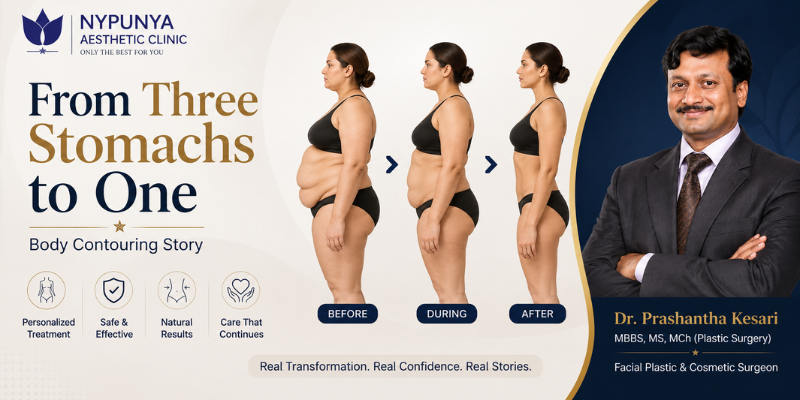
From Three Stomachs to One: Body Contouring Story
[By Dr. Prashantha Kesari N.K. | Nypunya Aesthetics Clinic, JP Nagar, Bengaluru ]
The decision to cross international borders for surgery is rarely a simple transaction. It is an act of profound vulnerability. When a patient boards a flight to India, as one did this past September to visit the Nypunya Aesthetic Clinic, they are carrying more than just luggage; they are carrying a lifetime of physical insecurity and the high-stakes hope that a stranger’s scalpel can deliver a new lease on life. In the world of medical tourism, the distance traveled is often proportional to the desperation for a result that feels like a rebirth.
Beyond the clinical success of the procedure, this journey reveals a deeper narrative about how medical trust is built across linguistic and cultural divides, and how “good services” can transform a worried patient into a powerful regional advocate.
Beyond Jargon: The “Three-Stomach” Metric
In the sterile world of plastic surgery, doctors often speak in the cold language of “abdominal contouring,” “adipose tissue excision,” and “fascial plication.” Yet, for the patient, these technicalities are secondary to the visceral reality of their own reflection. After undergoing what they termed “blood proction”—a phonetic interpretation of liposuction, likely coupled with a tummy tuck—the patient articulated their success with a clarity no medical textbook could match.
“Before I have three stomach now one stomach. Thank you very much.”
This simple metaphor cuts through the jargon. It describes the physical burden of multiple skin folds or localized fat deposits as a fragmented self. By moving from “three” to “one,” the patient isn’t just describing a flatter abdomen; they are describing a sense of wholeness. As an investigative look into patient satisfaction, this reminds us that the ultimate metric of a successful surgery is not found in the volume of liters removed, but in the patient’s ability to finally recognize themselves in the mirror.
The Anxiety of the “Swallow”
The immediate aftermath of surgery is a period of intense psychological fragility. In the source transcript, the patient expresses significant distress over “the swallow”—their term for the postoperative edema (swelling) that appeared on their stomach and, notably, their hands.
To a surgeon, swelling in the hands after a major abdominal procedure is a common physiological response to IV fluids and systemic inflammation. To a patient thousands of miles from home, however, it can feel like a sign of impending failure. This is where the “professionalism” of the Nypunya team became a clinical intervention in its own right.
The investigative reality of medical tourism is that surgical skill is only half the battle; the other half is the management of fear. By providing consistent, empathetic reassurance that “everything will be fine,” the staff mitigated the patient’s panic. This highlights a crucial takeaway for the industry: the most technically gifted surgeon will fail in the eyes of the patient if they cannot provide the emotional ballast required to navigate the “swallow” of recovery.
The Global Bridge: Continuity of Care
One of the most persistent critiques of international surgery is the “orphan patient” phenomenon—individuals who return home only to find local doctors unwilling or unable to manage their follow-up care. This patient’s experience suggests a more sophisticated model of global continuity.
The patient noted a plan to remain in touch with their local doctor “back home in case of anything.” High-quality international clinics no longer operate in a vacuum; they function as part of a globalized healthcare network. By encouraging this bridge between the Indian clinic and the patient’s local physician, Nypunya ensures a safety net that extends far beyond the discharge date. This transparency reduces the “medical wild west” stigma often associated with traveling abroad for care.
Trust as Currency: The Patient-Ambassador
The testimonial concludes not with a goodbye, but with a promise of expansion. The patient expresses a fervent desire to become an “ambassador” for the clinic, specifically mentioning getting in touch with the “regen”—likely referring to their home region or community network (suggesting an East African dialect and a strong communal trust structure).
“I will be the ambassador to this clinic you will see so many people coming under my name so we’ll be get in touch with the regen for other people to come.”
This shift from patient to regional connector is the lifeblood of the medical tourism industry. In many cultures, formal advertising carries less weight than the word-of-mouth testimony of a “transformed” neighbor. When a clinic delivers professional care that transcends the operating room, they aren’t just healing one individual; they are securing a foothold in an entire geographic region. Trust, in this context, is the most valuable currency a medical facility can earn.
The Lasting Impact of Professional Care
The journey from “three stomachs” to one is a testament to the power of modern aesthetic medicine, but the true lesson lies in the infrastructure of care. The successful “blood proction” provided the physical result, but the “good services” and professional reassurance provided the peace of mind.
As we look at the growing phenomenon of globalized healthcare, we must ask: When it comes to life-changing procedures, is the technical skill of the surgeon or the emotional reassurance of the staff what truly defines a successful journey? If this patient’s transformation is any indication, the answer is that the two are inseparable. Skill may change the body, but it is the professionalism and support that change the life.
What is body contouring surgery, and who is it suitable for?
Why do some patients choose both liposuction and a tummy tuck?
Is swelling normal after body contouring surgery?
How long does recovery usually take?
Will I have visible scars after a tummy tuck?
Is it safe to travel internationally for body contouring surgery?
How do I know if I am a good candidate for body contouring?
When will I see the final results
What should I look for when choosing a plastic surgeon for body contouring?
What is the most important factor for a successful body contouring journey?
Choosing the Right Plastic Surgeon
Selecting a plastic surgeon should involve much more than reviewing photographs or comparing techniques.
Patients should consider:
- Board certification and formal training in Plastic Surgery.
- Experience in performing both functional and aesthetic rhinoplasty.
- A thoughtful consultation that includes a detailed facial and nasal analysis rather than a standard treatment plan.
- An honest discussion about realistic expectations, limitations, risks, and recovery.
- Access to an accredited hospital with appropriate surgical infrastructure and patient safety protocols.
- A surgeon who is comfortable performing open, closed, structural, preservation, and revision rhinoplasty, selecting the technique that best suits the individual patient.
As I often tell my patients:
“Do not choose a surgeon because of the name of the technique. Choose a surgeon who understands the anatomy, has mastered multiple rhinoplasty techniques, and can customize the operation to your nose rather than making every nose fit the same operation.”
This philosophy consistently produces the most natural, functional, and long-lasting outcomes.
Why Choose Nypunya Aesthetics Clinic?
Every rhinoplasty at Nypunya Aesthetics Clinic is planned around the individual, not a fixed template. Dr. Prashantha Kesari combines functional and aesthetic goals in a single surgical plan, prioritizes patient safety through thorough pre-operative assessment, and provides structured long-term follow-up to track healing and final results. The underlying philosophy is facial harmony: a nose that supports breathing and belongs naturally on the patient’s own face, not a borrowed ideal.
About the Author
Dr. Prashantha Kesari N.K. — Senior Cosmetic Plastic Surgeon | M.Ch (Plastic Surgery), DNB, MRCS (Royal College of Surgeons, UK), DMLE, MBBS | Advanced Fellowship in Cosmetic & Laser Surgery | 20+ years of surgical experience | Pioneer of Ultrasonic Rhinoplasty & Endoscopic Scarless Facelift in Bengaluru | National gold medallist | Nypunya Aesthetics Clinic, JP Nagar, Bengaluru.
Disclaimer: This article is for educational and informational purposes only. Individual results and costs vary. Please consult directly with Dr. Prashantha Kesari for a personalised assessment before making any medical decision.

Category
Latest From Blog
Reclaiming Your Body: The Mommy Makeover Candidate Guide
Quiet Spaces Built on Two Decades of Discreet Care
C-Section Belly: Why Does Your Stomach Stay Big After Delivery?
Popular Tag