

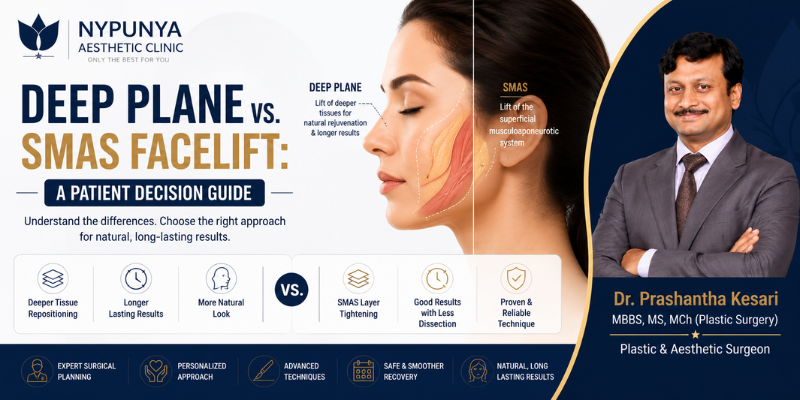
Deep Plane vs. SMAS Facelift: A Patient Decision Guide
[By Dr. Prashantha Kesari N.K. | Nypunya Aesthetics Clinic, JP Nagar, Bengaluru ]
No single surgical technique is optimal for every patient. This guide moves past marketing language to explain the real anatomical thinking that determines whether a deep plane or SMAS facelift is the right fit for a given face.
The Anatomical Framework Behind Every Facelift
Every facelift, regardless of technique, has to address the same layers of the face. Understanding these layers is the foundation for understanding why one technique may suit one patient and not another.
- Skin layer — ages independently and must be addressed in every facelift regardless of technique. Interventions include laser resurfacing, fractional lasers, nano fat grafting, biologicals, skin removal, and fascia filling for static creases.
- Subcutaneous fat layer — volume varies with age and BMI; deficits in specific areas need to be assessed and replaced.
- SMAS (Superficial Musculoaponeurotic System) — not merely a layer but a 3D anatomical structure separating the deep plane from the superficial plane. It extends from the skull to the clavicles and transitions into facial fascias and musculoaponeurotic structures. Its thickness varies significantly across facial regions.
- Deep plane — the zone beneath the SMAS where the major structural shifts of facial aging actually occur.
“No one surgical technique will be optimal for all patients. The philosophy should be to match the surgical technique to the face of the patient.”
The Core Technical Distinction
- SMAS lift: dissection above the SMAS layer (skin–SMAS plane)
- Deep plane lift: dissection below the SMAS layer, releasing ligaments and repositioning facial layers as a block
Deep Plane Facelift: How It Works
- Indication: When sagging or shift has occurred beneath the SMAS system — the most common scenario.
- Approach: Lifts the entire face as a single unit — no separation of layers above the SMAS.
- Why it works: Preserves the natural connection between the SMAS and the overlying subcutaneous and skin layers.
- Also called: The preservation facelift — maintains lymphatics and sensory nerve supply to the skin.
- Mechanism: Requires release of the retaining ligaments that tether the SMAS to underlying bone and between facial expression muscles. These ligaments hold sagged tissue in position; releasing and repositioning them addresses the root cause.
- Result: A more natural, longer-lasting lift because the root cause — ligament-held sag — is corrected, not just stretched.
- Caveat: Technically demanding; requires extensive training to master.
Patient Self-Assessment: The Finger-Pull Test
Stand in front of a mirror. Place two fingers slightly below the eye and lift toward the point between the ear and brow.
- Migration greater than 1 cm → the sag is likely in the sub-SMAS plane → you may be a candidate for a deep plane / preservation facelift.
- Migration less than 1 cm → the sag is superficial → SMAS plication is sufficient.
A dedicated video walking through this test has been referenced separately.
Age-Based Candidacy Guidelines
Age Group | Profile | Recommended Approach |
40s | Wants longevity, feature preservation, no rapid aging | Deep plane — releases ligaments, repositions, avoids delamination; ideal for maintenance/ preservation facelift |
40–50 | Minimal sag, good bone structure, lean face | SMAS-only facelift works well |
50–60 | Significant jowls, heavy face | Deep plane — lifting a heavy face is more logical than delaminating |
60+ | Significant laxity, submandibular looseness, bone resorption, skin needing resurfacing | Deep plane preservation — allows more aggressive skin work since skin is not delaminated |
Advantages of the Deep Plane Facelift
- Repositions facial layers in a more youthful position with long-lasting results
- Preserves the skin–SMAS connection — no unnatural delamination
- Bloodless operative field; minimal tissue handling
- Preserves lymphatics, blood vessels, and cutaneous structures
- Ideal for maintenance and preservation facelift protocols
Downsides and Considerations
- Steep learning curve; requires significant experience and specialized training
- Involves dissection close to facial motor nerves — demands precise nerve identification and preservation
- Not all plastic surgeons are trained or equipped for the deep plane technique
Key Takeaway for Patients
“Do not go by the technique. Meet a surgeon who has all the techniques in his armamentarium and customizes the facelift your face needs and deserves.”
- No two faces are the same — even the two halves of one face differ.
- The ideal surgeon should command deep plane, preservation, SMAS, and endoscopic techniques to match the result to the individual face.
Is a deep plane facelift painful?
Is deep plane safer than SMAS?
How long do the results last?
Is every patient a candidate for a deep plane facelift?
Does age matter when choosing between the two techniques?
Can a deep plane facelift also improve the neck?
Why Choose Nypunya Aesthetics Clinic?
Every rhinoplasty at Nypunya Aesthetics Clinic is planned around the individual, not a fixed template. Dr. Prashantha Kesari combines functional and aesthetic goals in a single surgical plan, prioritizes patient safety through thorough pre-operative assessment, and provides structured long-term follow-up to track healing and final results. The underlying philosophy is facial harmony: a nose that supports breathing and belongs naturally on the patient’s own face, not a borrowed ideal.
About the Author
Dr. Prashantha Kesari N.K. — Senior Cosmetic Plastic Surgeon | M.Ch (Plastic Surgery), DNB, MRCS (Royal College of Surgeons, UK), DMLE, MBBS | Advanced Fellowship in Cosmetic & Laser Surgery | 20+ years of surgical experience | Pioneer of Ultrasonic Rhinoplasty & Endoscopic Scarless Facelift in Bengaluru | National gold medallist | Nypunya Aesthetics Clinic, JP Nagar, Bengaluru.
Disclaimer: This article is for educational and informational purposes only. Individual results and costs vary. Please consult directly with Dr. Prashantha Kesari for a personalised assessment before making any medical decision.

Category
Latest From Blog
Non-Surgical Rhinoplasty: 5 Things Nose Fillers Cannot Fix
How Long Should You Stay in Bangalore Before Returning to the UK After a Facelift?
Moisture vs Hydration: What Does Your Skin Actually Need?
Popular Tag