

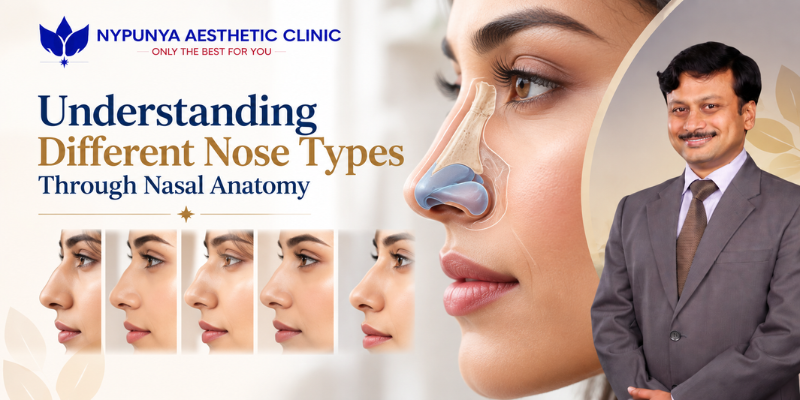
Understanding Different Nose Types Through Nasal Anatomy
[By Dr. Prashantha Kesari N.K. | Nypunya Aesthetics Clinic, JP Nagar, Bengaluru ]
A rhinoplasty consultation isn’t really about opinions on shape — it’s a structural diagnosis. The surgeon isn’t asking “what do you want,” first. They’re asking “what is this nose actually made of.”
Dr. Prashantha Kesari, senior cosmetic plastic surgeon at Nypunya Aesthetic Clinic (MCh, DNB, MRCS UK), approaches nasal anatomy the way most patients never get to see it explained — as a layered structural system, assessed the same way a surgeon would before planning any reconstructive procedure. Below is that framework, broken into clinical detail and plain-language explanation side by side.
The Nose as a Structural System, Not a Shape
Surgeons don’t see “a nose.” They see three separate zones stacked on top of each other, each behaving differently under the skin. A hump on the bridge and a droopy tip aren’t the same problem — they’re two different structures, sometimes needing two different fixes in the same surgery.
Zone 1 — The Bony Vault and the Keystone Area
Think of the keystone area as the load-bearing wall of the nose. It’s where bone meets cartilage near the top, and it holds the whole middle section up. Surgeons are extremely careful here — damage this junction, and the nose can literally cave in over time, a complication known as an inverted-V deformity.
Zone 2 — The Internal Nasal Valve and Mid-Vault
The internal nasal valve, formed by the angle between the septum and the upper lateral cartilage (normally 10–15°), is the narrowest point of the nasal airway and accounts for roughly 50% of total airway resistance. Narrowing this angle — whether congenitally or through over-aggressive dorsal reduction — is a leading cause of post-rhinoplasty breathing complaints.
Zone 3 — Tip Support Mechanisms
The tip of your nose isn’t just “cartilage” — it’s held up by a specific set of connective attachments, almost like tent poles and guy-ropes. If a surgeon removes too much cartilage without rebuilding this support system, the tip can slowly droop years after surgery — which is why short-term “before and after” photos can be misleading. The real test of technique shows up five to ten years later.
Skin-Soft Tissue Envelope (STSE) — Why Ethnicity Changes Everything
Skin thickness changes what surgery can actually achieve. Thin skin shows every detail of cartilage work underneath — for better or worse. Thick skin, much more common in South Indian patients, hides fine sculpting, which is why aggressive cartilage carving alone often doesn’t translate to a visibly sharper tip. It also means scar tissue can build up under thicker skin post-surgery, sometimes causing a puffy “ball” above the tip if not planned for in advance
Applying a Structural Classification to South Indian Rhinoplasty
Combining these anatomical zones, Dr. Kesari’s structural classification for South Indian and South Asian rhinoplasty candidates generally falls into recognizable patterns:
Low Radix / Flat Bridge Pattern
The bridge sits low near the eyes. Most Western rhinoplasty content focuses on removing a hump- but here, the more common need is often adding structure, not taking it away.
Thick-Skin Bulbous Tip Pattern
A round, soft-looking tip caused by weaker underlying cartilage and thicker skin on top. The fix is precise reshaping and stitching of the cartilage, not aggressive cutting — cutting too much here often backfires under thick skin.
Wide Alar Base Pattern
Wider nostrils relative to the eyes. This is one of the most sensitive corrections in rhinoplasty — done well, it’s subtle; overdone, it’s one of the hardest things to reverse.
Septal Deviation with Asymmetric Framework
A crooked nose, often with one nostril harder to breathe through — usually from an old injury or uneven growth. This needs both a cosmetic and a functional fix, done together.
Why This Level of Detail Actually Matters to a Patient
This isn’t academic detail for its own sake. It’s the difference between a surgeon who examines your actual bone, cartilage, and skin before making a plan — versus one who’s just trying to replicate a photo you brought in. The first approach is what holds up in year ten. The second usually doesn’t.
Dr. Kesari’s rhinoplasty consultations are built around this structural mapping first, aesthetic goals second — because the two have to work together, not against each other, for a result that looks natural rather than surgically altered.
Only The Best For You.
1. What does a rhinoplasty surgeon look at during a consultation?
2. What are the main structural areas of the nose assessed during rhinoplasty?
3. Why is the keystone area important in rhinoplasty?
4. What is the internal nasal valve, and why does it matter?
5. Why is tip support important in rhinoplasty?
6. How does skin thickness affect rhinoplasty results?
7. What are some common nose patterns seen in South Indian rhinoplasty patients?
8. Can a bulbous nose be corrected without aggressively removing cartilage?
9. Can rhinoplasty address both a crooked nose and breathing difficulty?
10. Why is structural analysis important before choosing a rhinoplasty technique?
Choosing the Right Plastic Surgeon
Selecting a plastic surgeon should involve much more than reviewing photographs or comparing techniques.
Patients should consider:
- Board certification and formal training in Plastic Surgery.
- Experience in performing both functional and aesthetic rhinoplasty.
- A thoughtful consultation that includes a detailed facial and nasal analysis rather than a standard treatment plan.
- An honest discussion about realistic expectations, limitations, risks, and recovery.
- Access to an accredited hospital with appropriate surgical infrastructure and patient safety protocols.
- A surgeon who is comfortable performing open, closed, structural, preservation, and revision rhinoplasty, selecting the technique that best suits the individual patient.
As I often tell my patients:
“Do not choose a surgeon because of the name of the technique. Choose a surgeon who understands the anatomy, has mastered multiple rhinoplasty techniques, and can customize the operation to your nose rather than making every nose fit the same operation.”
This philosophy consistently produces the most natural, functional, and long-lasting outcomes.
Why Choose Nypunya Aesthetics Clinic?
Every rhinoplasty at Nypunya Aesthetics Clinic is planned around the individual, not a fixed template. Dr. Prashantha Kesari combines functional and aesthetic goals in a single surgical plan, prioritizes patient safety through thorough pre-operative assessment, and provides structured long-term follow-up to track healing and final results. The underlying philosophy is facial harmony: a nose that supports breathing and belongs naturally on the patient’s own face, not a borrowed ideal.
About the Author
Dr. Prashantha Kesari N.K. — Senior Cosmetic Plastic Surgeon | M.Ch (Plastic Surgery), DNB, MRCS (Royal College of Surgeons, UK), DMLE, MBBS | Advanced Fellowship in Cosmetic & Laser Surgery | 20+ years of surgical experience | Pioneer of Ultrasonic Rhinoplasty & Endoscopic Scarless Facelift in Bengaluru | National gold medallist | Nypunya Aesthetics Clinic, JP Nagar, Bengaluru.
Disclaimer: This article is for educational and informational purposes only. Individual results and costs vary. Please consult directly with Dr. Prashantha Kesari for a personalised assessment before making any medical decision.

Category
Latest From Blog
Non-Surgical Rhinoplasty: 5 Things Nose Fillers Cannot Fix
How Long Should You Stay in Bangalore Before Returning to the UK After a Facelift?
Moisture vs Hydration: What Does Your Skin Actually Need?
Popular Tag