

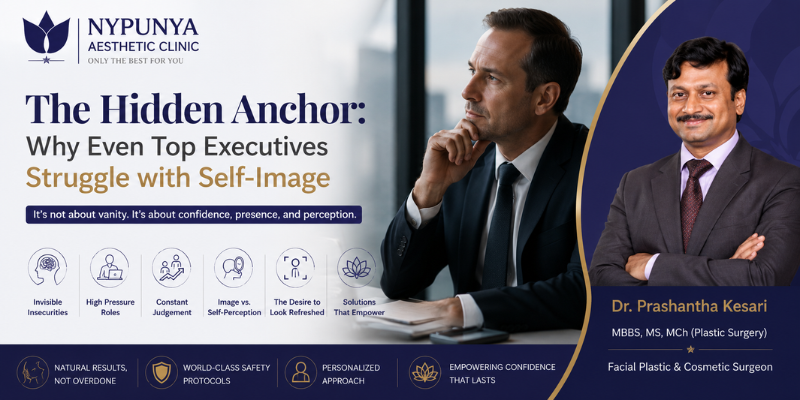
The Hidden Anchor: Why Even Top Executives Struggle with Self-Image
[By Dr. Prashantha Kesari N.K. | Nypunya Aesthetics Clinic, JP Nagar, Bengaluru ]
You command the boardroom. You navigate high-stakes negotiations with surgical precision, fuelled by years of experience and a mastery of the data. To your peers and your team, you are the archetype of the high-achieving leader. Yet, there is a recurring moment of friction: the millisecond you see your profile in a Zoom thumbnail or a press photo, and your internal momentum stalls.
This is the Professional Paradox. It is the jarring disconnect between an executive’s external competence and an internal self-image that feels compromised. You have optimized every workflow and mastered every KPI, yet you remain stifled by a “low confidence undercurrent” that has nothing to do with your professional ability and everything to do with how you perceive your physical presence.
The Silent Undercurrent of Low Confidence
For many top-tier professionals, the shape of the nose is not a minor vanity; it is a long-standing psychological tax. This insecurity often dates back to adolescence, a childhood ghost that has followed you into the C-suite. Carrying a decades-old insecurity into a high-performance environment generates a persistent friction that drains your executive presence.
This undercurrent operates beneath the surface of your successes, quietly siphoning off the mental energy you should be using to lead.
“You are on the top of the game when it comes to efficiency, experience, data regarding your job. But there is an undercurrent of low confidence which is always flowing.”
For the executive at the top of their game, this unresolved physical concern acts as a hidden anchor. It creates a subtle, persistent hesitation that contradicts the decisiveness your role demands.
Aligning Your Appearance with Your Professional Identity
Executive leadership requires a sense of total congruence. When you feel bold, decisive, and authoritative, but your mirror reflection suggests a “weak” or “distorted” profile, it creates a state of cognitive dissonance. This misalignment is more than a distraction; it is a barrier to authentic communication.
Your physical features should match your personality.
If you are a leader known for strength and approachability, your facial harmony should reinforce that narrative, not undermine it. Aligning your nose shape with your professional identity eliminates the mental clutter of self-consciousness. It allows you to present a unified front, ensuring that the confidence you project across the table is backed by a self-image that feels equally powerful.
Reshaping for Excellence
In the world of high performance, we talk constantly about ROI and strategic optimization. We upgrade our technology, refine our data sets, and invest in our physical health to maintain a competitive edge. It is time to view aesthetic wellness through that same lens. Addressing a nose shape that bothers you is not an act of vanity—it is a strategic optimization of your most important asset: yourself.
“If your nose shape is reducing your confidence, do not think twice. Get it reshaped.”
The logic of the elite professional is simple: identify the bottleneck and remove it. If a physical feature is reducing your confidence, it is actively limiting your professional ceiling. By reshaping that feature to match your persona, you fuel a direct boost in body image. This isn’t just about looking better; it is about reclaiming the confidence required to excel even further at work.
The Integrated Professional
The final stage of leadership development isn’t just about acquiring new skills; it is about achieving total integration. When your physical self-image finally aligns with your professional capability, the “undercurrent” of doubt disappears. You are no longer fighting a dual battle against the market and your own insecurities.
Success at the highest level demands an unshakable foundation. If you have mastered the data and the experience, why continue to carry an anchor that holds you back from total executive presence?
What is the one thing still preventing you from reaching your next level of success, and is it time you finally optimized it?
Why do successful executives become more conscious of their appearance as they age?
Is concern about facial aging a normal part of professional life?
Does facial rejuvenation improve confidence?
How do plastic surgeons determine whether someone is a candidate for facial rejuvenation?
Is surgery always necessary to address facial aging?
What is the difference between looking younger and looking natural?
At what age should someone consider facial rejuvenation?
How important is personalized treatment planning in aesthetic surgery?
Can aesthetic procedures affect professional image?
What advice does Dr. Prashantha Kesari give to professionals considering facial rejuvenation?
Why Choose Nypunya Aesthetics Clinic?
Every rhinoplasty at Nypunya Aesthetics Clinic is planned around the individual, not a fixed template. Dr. Prashantha Kesari combines functional and aesthetic goals in a single surgical plan, prioritizes patient safety through thorough pre-operative assessment, and provides structured long-term follow-up to track healing and final results. The underlying philosophy is facial harmony: a nose that supports breathing and belongs naturally on the patient’s own face, not a borrowed ideal.
About the Author
Dr. Prashantha Kesari N.K. — Senior Cosmetic Plastic Surgeon | M.Ch (Plastic Surgery), DNB, MRCS (Royal College of Surgeons, UK), DMLE, MBBS | Advanced Fellowship in Cosmetic & Laser Surgery | 20+ years of surgical experience | Pioneer of Ultrasonic Rhinoplasty & Endoscopic Scarless Facelift in Bengaluru | National gold medallist | Nypunya Aesthetics Clinic, JP Nagar, Bengaluru.
Disclaimer: This article is for educational and informational purposes only. Individual results and costs vary. Please consult directly with Dr. Prashantha Kesari for a personalised assessment before making any medical decision.

Category
Latest From Blog
Non-Surgical Rhinoplasty: 5 Things Nose Fillers Cannot Fix
How Long Should You Stay in Bangalore Before Returning to the UK After a Facelift?
Moisture vs Hydration: What Does Your Skin Actually Need?
Popular Tag