

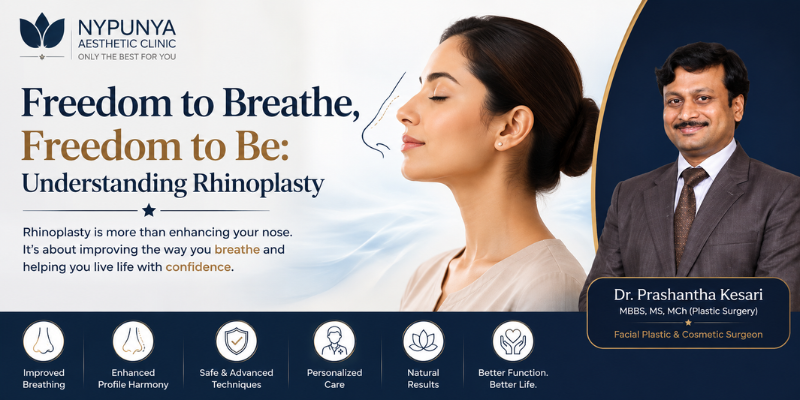
Freedom to Breathe, Freedom to Be: Understanding Rhinoplasty
[By Dr. Prashantha Kesari N.K. | Nypunya Aesthetics Clinic, JP Nagar, Bengaluru ]
A Plastic Surgeon’s Perspective, as India Marks 79 Years of Independence
On August 15th, we celebrate a freedom that was fought for in parliaments, on streets, and across borders. But there is a freedom that many of my patients fight for privately, in silence, for years before they ever step into a consultation room – the freedom to breathe without obstruction, and the freedom to see a face in the mirror that finally feels like their own. As a surgeon who has spent much of his career at the intersection of form and function, I find no procedure captures this dual liberation quite like rhinoplasty.
The nose as the seat of identity
Anatomically, the nose occupies perhaps six percent of the facial surface area. Psychologically, it occupies far more territory than that. Positioned at the visual and structural centre of the face, even minor irregularities in the nasal dorsum, tip, or base tend to register disproportionately in a person’s self-image — a phenomenon well documented in facial aesthetics literature and one I observe daily in consultation.
Independence Day is, at its core, a story of a nation refusing to let an imposed condition define its future. Many of my rhinoplasty patients are quietly doing the same thing at a personal, anatomical scale.
The many roads that lead to rhinoplasty
No two rhinoplasty patients arrive for identical reasons, and part of responsible surgical practice is recognising the distinct clinical categories that bring people to this decision.
Congenital and developmental irregularities. Some patients are born with a dorsal hump, a bulbous or under-projected tip, or a naturally wide nasal base that became more pronounced through adolescent growth. These are not “flaws” in any medical sense — simply variations in cartilage and bony architecture — but for the patient living with them daily, the psychological weight can be considerable.
Post-traumatic deformity. Nasal bones are among the most frequently fractured structures in the face, whether from sport, accident, or incident. A fracture that heals without proper septal alignment often results in visible deviation, asymmetry, or a bridge irregularity that becomes permanent without corrective intervention.
Functional airway obstruction. This is the category most underappreciated by the public and most important to me clinically. A deviated septum, enlarged turbinates, or internal/external nasal valve collapse can restrict airflow substantially, contributing to chronic mouth breathing, disrupted sleep architecture, and in some cases exacerbation of sleep-disordered breathing. For these patients, rhinoplasty (often performed as septorhinoplasty, combining cosmetic refinement with functional correction) is not an elective aesthetic choice but a restoration of a basic physiological freedom — the freedom to breathe fully through the nose, unaided, for the first time in years.
Revision cases. A meaningful proportion of patients I see have already undergone one rhinoplasty elsewhere and are seeking correction of an unsatisfactory outcome — over-resection of the dorsum, an unnatural “scooped” profile, tip asymmetry, or valve collapse introduced by the original surgery. Revision rhinoplasty is technically demanding, working as it does with altered cartilage frameworks and compromised soft-tissue envelopes, and it requires a level of structural planning considerably more exacting than a primary case.
Ethnic and structural considerations. For many Indian patients, thicker sebaceous skin, a lower dorsal profile, and specific tip cartilage characteristics require a surgical approach distinct from techniques developed primarily on thinner-skinned anatomies. Respecting these structural realities — rather than imposing a generic aesthetic template — is essential to a result that reads as natural rather than surgically altered.
How I approach the surgery
My technique is selected on a case-by-case basis between open and closed septorhinoplasty approaches, guided by the complexity of the correction required, cartilage quality, skin thickness, and whether functional airway work is needed alongside cosmetic refinement. Cartilage grafting — often harvested from the septum, and in more complex or revision cases from the ear or rib — allows structural support to be added rather than simply subtracted, which is part of why I favour a preservation-oriented philosophy wherever the anatomy allows it. The objective is never to impose a smaller or more “Western” nose; it is to resolve the specific structural issue in front of me while preserving ethnic facial harmony and, critically, nasal airway function.
This is also why I place significant weight on functional airway assessment even in patients presenting with a purely cosmetic complaint. A nose that looks refined but breathes poorly has not been fully treated. Independence, medically speaking, is incomplete if it is only skin-deep.
Why NRI patients specifically seek this expertise
A significant proportion of the patients who travel to us — from the UK, the US, Singapore, and the Gulf — do so because MRCS (UK) surgical training carries a specific, internationally recognised assurance of structural rigor, particularly relevant to a procedure where millimetric precision determines the difference between a natural result and a visibly “done” one. For patients balancing limited travel windows against the desire for a definitive, single-trip correction, that assurance matters considerably.
Recovery: the interval between surgery and freedom
Rhinoplasty recovery follows a fairly predictable arc — splinting for approximately one to two weeks, with the majority of visible swelling and bruising resolving within three to four weeks, though final refinement of the tip and skin envelope continues to settle over twelve to eighteen months. I tell patients this candidly, because the freedom rhinoplasty offers is not instantaneous; it is, much like nation-building, an unfolding process rather than a single event.
A closing reflection
Seventy-nine years ago, independence was won not merely as a change of flag, but as the right to self-determination — the right to define one’s own future on one’s own terms. Rhinoplasty, at its best, offers something structurally similar at an individual scale: the right to breathe without obstruction, and the right to a face that finally aligns with one’s own sense of self, rather than one shaped by an accident of birth, injury, or a previous surgeon’s misjudgement. That, to me, is what freedom to breathe and freedom to be genuinely means in the context of aesthetic and functional surgery.
Nypunya Aesthetic Clinic — Only The Best For You.
What does “Freedom to Breathe” mean in rhinoplasty?
Can rhinoplasty give me both freedom to breathe and freedom to feel confident?
What types of nasal problems can rhinoplasty address?
Is rhinoplasty only about changing the appearance of the nose?
How does Dr. Prashantha Kesari approach rhinoplasty?
What is ethnic rhinoplasty, and why is it important for Indian patients?
Can revision rhinoplasty restore freedom after an unsuccessful previous surgery?
What role do cartilage grafts play in rhinoplasty?
How long does it take to experience the final results of rhinoplasty?
How does Independence Day relate to freedom in rhinoplasty?
Choosing the Right Plastic Surgeon
Selecting a plastic surgeon should involve much more than reviewing photographs or comparing techniques.
Patients should consider:
- Board certification and formal training in Plastic Surgery.
- Experience in performing both functional and aesthetic rhinoplasty.
- A thoughtful consultation that includes a detailed facial and nasal analysis rather than a standard treatment plan.
- An honest discussion about realistic expectations, limitations, risks, and recovery.
- Access to an accredited hospital with appropriate surgical infrastructure and patient safety protocols.
- A surgeon who is comfortable performing open, closed, structural, preservation, and revision rhinoplasty, selecting the technique that best suits the individual patient.
As I often tell my patients:
“Do not choose a surgeon because of the name of the technique. Choose a surgeon who understands the anatomy, has mastered multiple rhinoplasty techniques, and can customize the operation to your nose rather than making every nose fit the same operation.”
This philosophy consistently produces the most natural, functional, and long-lasting outcomes.
Why Choose Nypunya Aesthetics Clinic?
Every rhinoplasty at Nypunya Aesthetics Clinic is planned around the individual, not a fixed template. Dr. Prashantha Kesari combines functional and aesthetic goals in a single surgical plan, prioritizes patient safety through thorough pre-operative assessment, and provides structured long-term follow-up to track healing and final results. The underlying philosophy is facial harmony: a nose that supports breathing and belongs naturally on the patient’s own face, not a borrowed ideal.
About the Author
Dr. Prashantha Kesari N.K. — Senior Cosmetic Plastic Surgeon | M.Ch (Plastic Surgery), DNB, MRCS (Royal College of Surgeons, UK), DMLE, MBBS | Advanced Fellowship in Cosmetic & Laser Surgery | 20+ years of surgical experience | Pioneer of Ultrasonic Rhinoplasty & Endoscopic Scarless Facelift in Bengaluru | National gold medallist | Nypunya Aesthetics Clinic, JP Nagar, Bengaluru.
Disclaimer: This article is for educational and informational purposes only. Individual results and costs vary. Please consult directly with Dr. Prashantha Kesari for a personalised assessment before making any medical decision.

Category
Latest From Blog
Non-Surgical Rhinoplasty: 5 Things Nose Fillers Cannot Fix
How Long Should You Stay in Bangalore Before Returning to the UK After a Facelift?
Moisture vs Hydration: What Does Your Skin Actually Need?
Popular Tag