

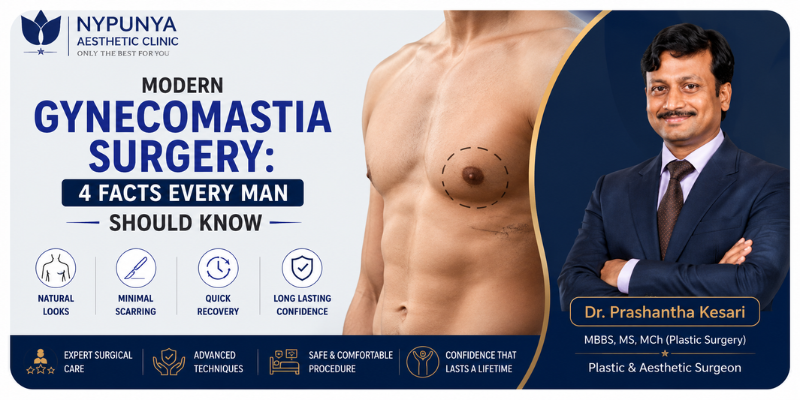
Modern Gynecomastia Surgery: 4 Facts Every Man Should Know
[By Dr. Prashantha Kesari N.K. | Nypunya Aesthetics Clinic, JP Nagar, Bengaluru ]
If you’ve spent years hiding under baggy t-shirts, avoiding pool days, or dreading a shirtless summer, this is the piece you’ve been waiting to read.
For many men, gynecomastia—the overdevelopment of male breast tissue—is a silent architect of profound social and physical insecurity. Historically, the path to correction was often paved with surgical apprehension, as patients weighed the benefits of a flatter chest against the risks of prominent scarring and the dreaded “scooped-out” look. Traditional methods were often blunt instruments for a delicate problem.
However, a quiet revolution is currently reshaping the landscape of male aesthetics. Led by pioneers like Dr. Prashantha Kesari, modern chest contouring has transcended basic surgery to become a high-tech discipline defined by anatomical precision. By moving away from aggressive excision and toward minimally invasive finesse, the procedure has been reimagined as a sophisticated art form.
- Strategic Stealth: The 4mm Lateral Approach
The first hallmark of this technical evolution is the abandonment of conspicuous incisions. While legacy techniques often left visible markers across the front of the chest, contemporary protocols utilize a tiny, 4mm entry point.
Crucially, this incision is strategically relocated to the side of the chest. By placing the port in the lateral shadow of the pectoralis or the axilla (armpit) area, the surgeon ensures that the entry point is virtually invisible to the naked eye. This shift is a game-changer for patient confidence; it hides the “telltale” signs of surgical intervention in the body’s natural contours, allowing the patient to achieve a restored masculine profile without the social burden of a surgical signature.
- Kinetic Emulsification: Liquefaction Over Traditional Cutting
One of the most significant leaps in medical technology is the shift from mechanical cutting—often involving traumatic tissue avulsion or tearing—to power-assisted emulsification. Dr. Kesari utilizes a specialized power-assisted device that employs kinetic energy to break down tissue at a molecular level before extraction.
“We use a power assisted device to liquefy the entire fat and to liquefy even the gland element…”
By liquefying both the adipose (fatty) and the more resilient glandular elements, the surgeon can aspirate the tissue through the narrow 4mm port with far less trauma to the surrounding vascular and nervous structures. This “gentler” approach results in a significantly more uniform chest surface, avoiding the lumps and irregularities often left behind by older, more aggressive manual methods.
- The Trans-Nipple Path for Fibrous Remnants
While power-assisted technology can handle the vast majority of tissue, certain dense, fibrous glandular remnants may resist liquefaction. In these instances, the surgical path chosen for extraction is the difference between a mediocre result and a masterpiece. Traditionally, surgeons might cut around the perimeter of the areola, but this transition zone is notorious for healing with visible, high-contrast scarring.
Instead, Dr. Kesari employs a counter-intuitive maneuver: going directly through the nipple to access the specific gland tissue that did not liquefy during the initial phase. Anatomically, the nipple is a highly textured structure, making it an ideal “biological camouflage” for an incision. Unlike the smooth skin of the areola border, the nipple’s unique landscape hides scars with remarkable efficiency, ensuring that the final aesthetic is not compromised by the removal of stubborn tissue.
- The Architectural Cushion: Preventing the “Saucer Deformity”
Perhaps the most critical nuance in modern contouring is knowing when to stop. A common pitfall of less experienced surgeons is the “saucer deformity,” an unnatural, hollowed-out indentation where the nipple appears to have collapsed into the chest. This occurs when the surgical site is over-cleared, leaving no structural support behind.
“…we leave a small [disk] of tissue under the nipple areola so that the nipple will not stick to the underlying muscle causing a saucer deformity.”
Expert handling requires the preservation of this strategic “disk” of tissue. This remaining layer acts as a structural buffer—a cushion that prevents the nipple-areola complex from adhering directly to the pectoral muscle. By maintaining this thin anatomical layer, the surgeon ensures a natural projection and a smooth, masculine transition across the entire chest wall.
Who This Precision Approach Is Built For
This level of nuance isn’t reserved for a rare few—it’s designed for the everyday man who has quietly lived with this concern for years. You may be a strong candidate for this refined approach if:
→ Diet and exercise have failed to change the shape or firmness of your chest, no matter how disciplined your routine. → You’ve avoided fitted shirts, swimwear, or intimacy because of self-consciousness about your chest. → You’re wary of surgery because of stories of visible scarring or an unnatural “hollowed” result. → You want a solution that restores a masculine chest contour without months of downtime or an obvious surgical giveaway.
If any of this sounds familiar, the good news is that the surgical apprehension that kept you waiting no longer needs to apply. The techniques described above exist precisely to remove the two biggest fears—visible scars and an unnatural result—from the equation.
Conclusion: Precision as the New Standard
The evolution of gynecomastia treatment signals a new era where technology and surgical “finesse” are inseparable. The transition from aggressive cutting to precise emulsification, combined with strategic lateral access and the preservation of structural tissue disks, defines the new gold standard of care. These sophisticated nuances ensure that the procedure is no longer merely an act of reduction, but one of high-definition anatomical sculpting.
As the intersection of medical tech and surgical artistry continues to refine the human form, it invites a compelling question for the future of male body image: how will our perception of self-improvement evolve as the “work” itself becomes truly, beautifully invisible?
Your Next Step
The only way to know how this precision approach applies to your specific chest anatomy is a one-on-one evaluation with Dr. Prashantha Kesari. A consultation costs you nothing but a conversation, and it’s the fastest way to move from years of quiet frustration to a clear, personalized plan.
→ Book a confidential consultation to discuss your chest concerns directly with Dr. Kesari. → Get a personalized assessment of which technique—lateral emulsification, trans-nipple access, or both—fits your anatomy. → Walk away with a clear picture of timeline, recovery, and results, so you can decide with confidence rather than guesswork.
You’ve waited long enough to hide the same concern under the same shirts. Take the first step today. The chest you’ve been working toward under every layer of clothing doesn’t have to stay hidden for another summer, another wardrobe change, or another year of avoidance—one conversation is enough to find out exactly what’s possible for you.
Only The Best For You.
Is modern gynecomastia surgery really scarless?
Why doesn't diet or exercise fix gynecomastia?
What is the difference between traditional and modern gynecomastia surgery?
Why is a small amount of tissue left behind during surgery?
How long is recovery after gynecomastia surgery?
Can gynecomastia come back after surgery?
Will my chest look natural after surgery?
Why does Dr. Prashantha Kesari use power-assisted technology?
Is gynecomastia surgery painful?
Choosing the Right Plastic Surgeon
Selecting a plastic surgeon should involve much more than reviewing photographs or comparing techniques.
Patients should consider:
- Board certification and formal training in Plastic Surgery.
- Experience in performing both functional and aesthetic rhinoplasty.
- A thoughtful consultation that includes a detailed facial and nasal analysis rather than a standard treatment plan.
- An honest discussion about realistic expectations, limitations, risks, and recovery.
- Access to an accredited hospital with appropriate surgical infrastructure and patient safety protocols.
- A surgeon who is comfortable performing open, closed, structural, preservation, and revision rhinoplasty, selecting the technique that best suits the individual patient.
As I often tell my patients:
“Do not choose a surgeon because of the name of the technique. Choose a surgeon who understands the anatomy, has mastered multiple rhinoplasty techniques, and can customize the operation to your nose rather than making every nose fit the same operation.”
This philosophy consistently produces the most natural, functional, and long-lasting outcomes.
Why Choose Nypunya Aesthetics Clinic?
Every rhinoplasty at Nypunya Aesthetics Clinic is planned around the individual, not a fixed template. Dr. Prashantha Kesari combines functional and aesthetic goals in a single surgical plan, prioritizes patient safety through thorough pre-operative assessment, and provides structured long-term follow-up to track healing and final results. The underlying philosophy is facial harmony: a nose that supports breathing and belongs naturally on the patient’s own face, not a borrowed ideal.
About the Author
Dr. Prashantha Kesari N.K. — Senior Cosmetic Plastic Surgeon | M.Ch (Plastic Surgery), DNB, MRCS (Royal College of Surgeons, UK), DMLE, MBBS | Advanced Fellowship in Cosmetic & Laser Surgery | 20+ years of surgical experience | Pioneer of Ultrasonic Rhinoplasty & Endoscopic Scarless Facelift in Bengaluru | National gold medallist | Nypunya Aesthetics Clinic, JP Nagar, Bengaluru.
Disclaimer: This article is for educational and informational purposes only. Individual results and costs vary. Please consult directly with Dr. Prashantha Kesari for a personalised assessment before making any medical decision.

Category
Latest From Blog
Non-Surgical Rhinoplasty: 5 Things Nose Fillers Cannot Fix
How Long Should You Stay in Bangalore Before Returning to the UK After a Facelift?
Moisture vs Hydration: What Does Your Skin Actually Need?
Popular Tag