

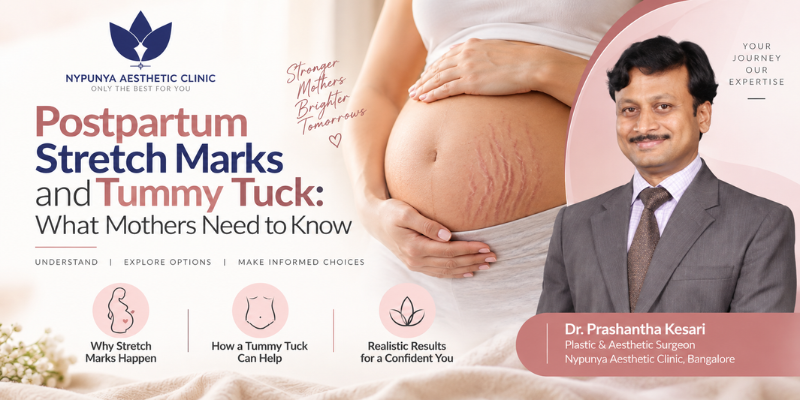
Postpartum Stretch Marks and Tummy Tuck: What Mothers Need to Know
[By Dr. Prashantha Kesari N.K. | Nypunya Aesthetics Clinic, JP Nagar, Bengaluru ]
Stretch marks are one of the most common – and most misunderstood – changes mothers notice on their bodies after pregnancy. They show up on the belly more than almost anywhere else, and for many women, they become a lasting reminder of a body that stretched far beyond what it once was. According to Dr. Prashantha Kesari, senior cosmetic plastic surgeon at Nypunya Aesthetic Clinic, understanding why these marks form is the first step to understanding what can realistically be done about them.
“I see this concern in almost every postpartum consultation,” says Dr. Kesari. “Women want to know two things: why did this happen to me, and can it be fixed? The honest answer to both questions is more nuanced than most people expect.”
What a Stretch Mark Actually Is
To understand why stretch marks form, it helps to understand the structure of the skin itself. Skin has three layers: the outer epidermis, the deeper dermis, and the fatty layer beneath. The dermis contains collagen and elastin fibers – the proteins responsible for keeping skin firm and stretchy at the same time.
“During pregnancy, the belly expands at a pace the skin simply isn’t built for,” Dr. Kesari explains. “When the dermis is stretched faster and further than its collagen and elastin fibers can comfortably handle, those fibers actually tear at a microscopic level. What we see on the surface as a stretch mark is really the visible result of that deeper tearing and the scar-like tissue that forms as the skin tries to repair itself.”
This is why stretch marks often start out reddish, pink, or purple – they’re new scar tissue with active blood vessels close to the surface – before gradually fading to a lighter, silvery-white tone as the tissue matures and blood supply reduces. “Once they reach that mature, pale stage, they are essentially a permanent change in the skin’s structure at that spot,” he notes. “That’s an important thing for mothers to understand early on, because it changes what ‘removal’ realistically means.”
Why Some Women Get Them and Others Don’t
One of the most frustrating aspects of stretch marks, according to Dr. Kesari, is how unevenly they affect different women – even under similar circumstances. “Two mothers can have very similar pregnancies, similar weight gain, similar baby size, and one will develop significant stretch marks while the other has almost none. This isn’t about effort or how well someone moisturized. It comes down to a combination of factors that are largely outside a person’s control.”
He outlines the main contributors:
- Genetics: A family history of stretch marks – in a mother, sister, or grandmother – significantly increases the likelihood of developing them. Skin’s natural collagen strength and elasticity are, to a large degree, inherited.
- Rate and amount of skin stretching: Rapid weight gain during pregnancy, carrying twins or multiples, or a larger baby all increase the speed and degree of stretching, raising the risk.
- Hormonal changes: Pregnancy hormones, particularly increased cortisol and relaxin, can actually weaken collagen fibers, making skin more prone to tearing under stretch – independent of how much the belly physically expands.
- Skin type and age: Younger skin tends to have more elastin and can sometimes tolerate stretching better, while skin that is already less elastic – due to age or previous rapid weight changes – is more vulnerable.
- Multiple pregnancies: Each subsequent pregnancy adds further stretch to skin that may already have reduced elasticity from a previous one, which is why marks often become more pronounced with each child.
“None of these factors are things a woman actively did wrong,” Dr. Kesari emphasizes. “This is one of the most common sources of unnecessary guilt I hear from patients, and it’s simply not accurate. Stretch marks are a structural response to stretch and hormones – not a failure of skincare or self-discipline.”
Where Stretch Marks Typically Form on the Postpartum Belly
Understanding the pattern of where marks appear matters, because it directly affects what treatment can achieve. Dr. Kesari explains that stretch marks from pregnancy tend to follow a fairly predictable distribution.
“Most postpartum stretch marks concentrate on the lower abdomen – generally from the belly button down toward the pubic area – because that’s the region of skin under the most direct, sustained stretch as the uterus grows,” he says. “Marks can also appear on the sides of the abdomen, and in some women, above the belly button as well, particularly with larger pregnancies or twins.”
This distribution becomes especially relevant when discussing surgical options, because a tummy tuck does not treat the entire abdomen uniformly – it specifically removes skin from a defined lower section.
How a Tummy Tuck Actually Removes Stretch Marks
Here, Dr. Kesari is precise about what the procedure does and does not accomplish, because he believes overselling results does a real disservice to patients.
“A tummy tuck doesn’t ‘treat’ stretch marks the way a topical or surface treatment claims to fade them. It physically removes the section of skin they’re sitting on,” he explains. “During the procedure, we remove the loose, excess skin of the lower abdomen – typically from just above the belly button down to the bikini line – and then bring the remaining skin down and tighten it into place.”
Because the majority of postpartum stretch marks form in exactly this lower zone, a well-planned tummy tuck often removes a significant portion of them entirely, simply because that section of skin is excised during surgery. “For many of my patients, this is actually one of the most satisfying, unexpected outcomes of the procedure. They come in primarily concerned about loose skin and muscle separation, and leave having also removed the section of skin carrying most of their stretch marks.”
However, he’s equally clear about the procedure’s limits. “This only removes marks located within the skin that’s actually excised – generally the lower abdominal zone. Stretch marks positioned above the belly button, on the upper abdomen, or on the sides beyond the treatment area typically remain, because that skin isn’t part of what’s removed during a standard tummy tuck. The remaining skin is tightened and repositioned, but it isn’t replaced.”
He also notes that the umbilicus (belly button) itself is repositioned during the procedure, and stretch marks in that immediate area may shift slightly in appearance as a result, though they aren’t removed unless they fall within the excised section.
Setting the Right Expectations Before Surgery
Because expectations matter so much with this particular concern, Dr. Kesari always walks patients through a simple, honest mapping exercise during consultation. “I ask patients to show me exactly where their marks are concentrated. If the majority sit in the lower abdomen, I can tell them with real confidence that surgery will likely remove most of them. If marks are spread more broadly across the upper abdomen too, I explain clearly that those areas will remain visible after surgery, even though the overall shape and tightness of the abdomen will be dramatically improved.”
This kind of clear mapping, he says, prevents the most common source of post-surgical disappointment. “Nobody should come out of surgery surprised that marks above their belly button are still there. That’s not a complication – it’s simply outside what this particular procedure is designed to address, and I make sure every patient understands that before we ever discuss surgery dates.”
A Combined Outcome, Not a Single Fix
Dr. Kesari frames the removal of lower-abdomen stretch marks as one meaningful part of a tummy tuck’s overall result – alongside muscle repair and skin tightening – rather than the primary reason to consider the procedure. “Patients who come in mainly because of stretch marks are often surprised that the bigger, more life-changing part of the surgery is actually the muscle repair – fixing that separated core that’s been causing back discomfort and a persistent bulge. The stretch mark removal in the lower zone is a genuine, welcome bonus, but it works best as part of that fuller picture, not as a standalone goal.”
An Honest Starting Point
For mothers frustrated by stretch marks that haven’t faded with time, moisturizer, or patience, Dr. Kesari’s advice starts with information rather than assumptions. “Understand where your marks actually sit on your body, and understand clearly what a tummy tuck can and can’t reach. When patients come in with realistic expectations, satisfaction after surgery is consistently high – because there are no surprises, only results that match exactly what was discussed beforehand.”
1. Can a tummy tuck remove postpartum stretch marks?
2. What causes stretch marks after pregnancy?
3. Can stretch marks disappear completely after childbirth?
4. What is the best treatment for postpartum stretch marks?
5. Can a tummy tuck tighten loose skin after pregnancy?
6. Is a tummy tuck suitable for every mother after pregnancy?
7. How long should I wait after childbirth before considering a tummy tuck?
8. Can I combine tummy tuck surgery with stretch mark treatments?
9. Will a tummy tuck prevent stretch marks from developing during another pregnancy?
10. How can I find out whether tummy tuck or stretch mark treatment is right for me?
Choosing the Right Plastic Surgeon
Selecting a plastic surgeon should involve much more than reviewing photographs or comparing techniques.
Patients should consider:
- Board certification and formal training in Plastic Surgery.
- Experience in performing both functional and aesthetic rhinoplasty.
- A thoughtful consultation that includes a detailed facial and nasal analysis rather than a standard treatment plan.
- An honest discussion about realistic expectations, limitations, risks, and recovery.
- Access to an accredited hospital with appropriate surgical infrastructure and patient safety protocols.
- A surgeon who is comfortable performing open, closed, structural, preservation, and revision rhinoplasty, selecting the technique that best suits the individual patient.
As I often tell my patients:
“Do not choose a surgeon because of the name of the technique. Choose a surgeon who understands the anatomy, has mastered multiple rhinoplasty techniques, and can customize the operation to your nose rather than making every nose fit the same operation.”
This philosophy consistently produces the most natural, functional, and long-lasting outcomes.
Why Choose Nypunya Aesthetics Clinic?
Every rhinoplasty at Nypunya Aesthetics Clinic is planned around the individual, not a fixed template. Dr. Prashantha Kesari combines functional and aesthetic goals in a single surgical plan, prioritizes patient safety through thorough pre-operative assessment, and provides structured long-term follow-up to track healing and final results. The underlying philosophy is facial harmony: a nose that supports breathing and belongs naturally on the patient’s own face, not a borrowed ideal.
About the Author
Dr. Prashantha Kesari N.K. — Senior Cosmetic Plastic Surgeon | M.Ch (Plastic Surgery), DNB, MRCS (Royal College of Surgeons, UK), DMLE, MBBS | Advanced Fellowship in Cosmetic & Laser Surgery | 20+ years of surgical experience | Pioneer of Ultrasonic Rhinoplasty & Endoscopic Scarless Facelift in Bengaluru | National gold medallist | Nypunya Aesthetics Clinic, JP Nagar, Bengaluru.
Disclaimer: This article is for educational and informational purposes only. Individual results and costs vary. Please consult directly with Dr. Prashantha Kesari for a personalised assessment before making any medical decision.

Category
Latest From Blog
The Ethics of Surgical Excellence and Professional Confidence
NMC 2026 & Medical Ethics: Why Results Cannot Be Guaranteed
Oily but Tight Skin: Causes & Skincare Tips
Popular Tag